On September 28, 2025, Todd-Avery Lenahan stood inside Wynn Las Vegas and talked about a building 12,000 kilometres away. The president and chief creative officer of Wynn Design & Development was leading a property tour for The National, the UAE's largest English-language newspaper, and the conversation kept circling back to a 70-story tower on a man-made island in the Arabian Gulf that he had been designing for over three years.
The tower had reached its 70th floor by this point, with room fit-outs underway across 98% of accommodations. But Lenahan was not talking about progress reports. He described a theatre that would open with a show "quite unlike anything we have done before," produced by a London company he declined to name. He described a supper club called Delilah whose fictional patron, modelled on 1950s Hollywood showgirls in Las Vegas, would be reimagined in RAK as a character "inspired by an entertainment industry icon from Beirut." He described a Sea of Dreams water and light show visible from the majority of the resort's 22 restaurants, viewed from a different angle at every table. And he used a phrase that, the more you understand about how Lenahan works, explains the entire building: veiling and revealing.
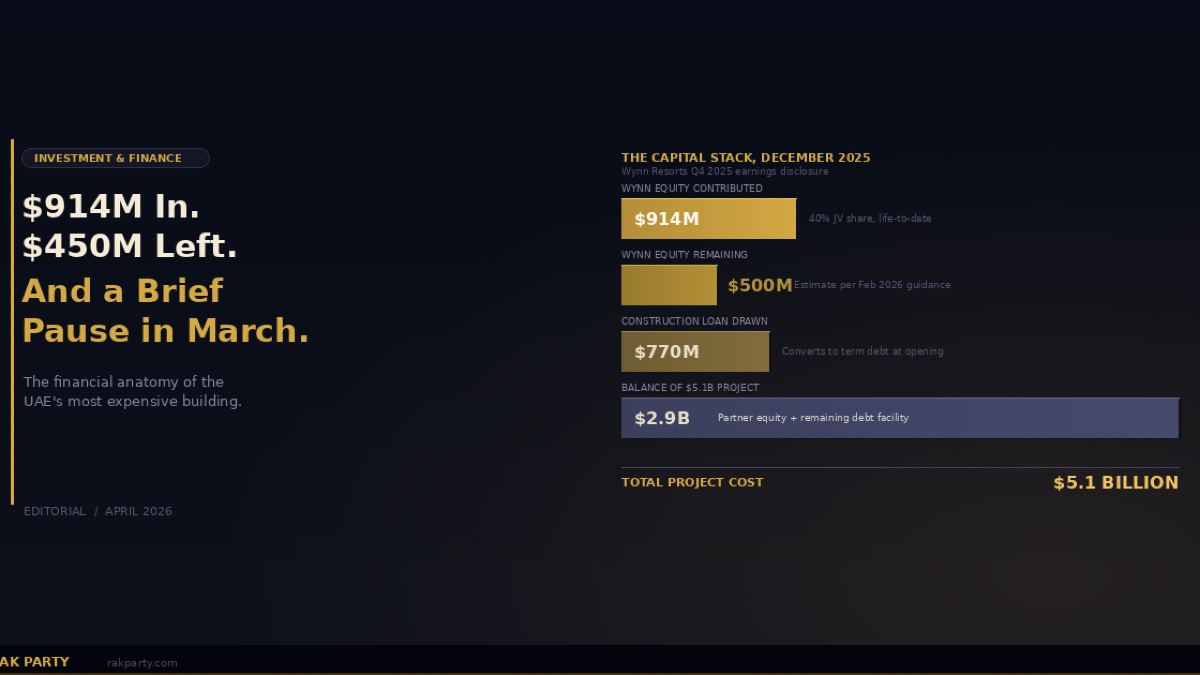
Wynn Al Marjan Island is a $5.1 billion resort. It is the UAE's first integrated casino property. It opens in spring 2027 and stands 305 metres above the Arabian Gulf. But those are facts about money and height. The story that nobody has told is about the person making the design decisions, and about why a casino company decided, 20 years ago, that it needed its own architecture firm.
From Disney Imagineering to Steve Wynn's Living Room
Lenahan's career traces a line that is difficult to replicate because the institutions he passed through no longer operate the same way. He started at Gensler in Washington, D.C. in 1990, moved to The Walt Disney Company the same year, and spent nearly a decade at Walt Disney Imagineering, eventually becoming Principal of Design and Interior Architecture for the company's global portfolio. He left Disney in 1999 to found TAL Studio, but continued collaborating with the company for another 21 years, until 2020.
Between those two roles, he designed over 200 hotels across five continents and eight tropical islands. His client list reads like a catalogue of pre-2020 luxury hospitality: Four Seasons, Mandarin Oriental, Ritz-Carlton, Auberge Resorts, Nobu Hospitality, Viceroy Hotels. He designed all of Larry Ellison's resort developments on the island of Lanai in Hawaii. He designed Steve Wynn's personal home. In 2008, Boutique Design magazine named him Designer of the Year. In 2010, he became the youngest person ever inducted into the HD Platinum Circle, an award that recognises lifetime achievement in hospitality design.
He also designed show rooms in the Encore at Wynn Las Vegas, taught architecture at UNLV as an adjunct professor, and earned executive education credentials from Harvard's Graduate School of Design. His mother was a designer. His grandfather was a mechanical engineer. The career was, in one sense, inevitable. In another sense, it was the specific accumulation of experiences (Disney's obsession with narrative space, Wynn's obsession with operational detail, and 200 hotels' worth of understanding what works when 10,000 guests move through a building every day) that made him the person Wynn Resorts eventually absorbed.
Why a Casino Company Hired Its Own Architecture Firm
In 2019, TAL Studio merged with Wynn Design & Development. The Las Vegas Review-Journal reported the news. Lenahan joined DeRuyter Butler, Wynn's chief architect, who had been a principal collaborator in the design of The Mirage, the Bellagio, and every Wynn and Encore property built in Las Vegas, Macau, and Boston. The combined team moved into the Wynn Design Center near Wynn Las Vegas.
That merger is the decision that makes Wynn Al Marjan Island possible in its current form. Most hotel companies outsource design. They hire an architecture firm, brief them, review their work, and manage the gap between what the designer imagines and what the operator needs. The process involves translation at every stage, and translation introduces friction, compromise, and delay.
Wynn eliminated the gap. Today, WDD operates as a vertically integrated design studio with over 200 architects, interior designers, landscape architects, lighting designers, artists, digital designers, production designers, construction managers, and procurement agents across four global offices. They manage a $15 billion existing portfolio and an additional $10 billion of new design and development underway on three continents. No other resort operator in the world maintains this structure. The consequence is that the person who designs the light fixture in an Enclave bathroom sits in the same office as the person who designs the casino floor layout and the person who designs the landscaping around the marina.
The Original InsightWynn's 200-person in-house design team is structurally unique in the global resort industry. The nearest comparison is Disney Imagineering, where Lenahan spent a decade. When the designer and the operator are the same entity, every detail in the building can be conceived with full knowledge of how it will be used, maintained, and experienced at scale. That is why the phrase "veiling and revealing" is not marketing language. It is an operational design philosophy that can only work when the design team controls every sight line, every material choice, and every transition between spaces.
"Veiling and Revealing": What the Phrase Actually Means
When Lenahan described Enclave's design philosophy in the July 2025 PR Newswire announcement, he said this:
"Every dimension of our design process in creating this jewel within Wynn Al Marjan Island's crown has been as artful and precise as cutting and polishing the facets of a rare and priceless gem. As with the overall resort's design concept of 'veiling and revealing' at every turn, it's often what's not seen that is more alluring and beautiful than what's obvious. That's what makes the rarefied veil of Enclave so special."Todd-Avery Lenahan, via Inside Asian Gaming and PR Newswire, July 2, 2025
Strip the corporate language and the idea is architectural. You never see the full building from any single position. You arrive through a guarded drive and enter a lobby that reveals a processional gallery. The gallery leads to private elevators. The elevators open onto a floor with no more than 15 suites. Each suite faces the Arabian Gulf through floor-to-ceiling windows dressed in platinum, sapphire, cream, gold, and sea mist. But the beach is below you, the marina is behind you, the casino is beneath you, and the Sea of Dreams show is playing to your left across the water. You cannot see all of it at once. You are meant to discover it over hours, over days.
The same principle applies outside Enclave. The 22 restaurants are positioned along a terrace so that each one frames a different view of the poolscape, beach, and Gulf. Lenahan told The National that "it's quite an incredible collection of restaurants, all of which will be taking advantage of beautiful views out to the ocean." The shopping parterre is skylit and lined with flowering gardens. The nightclub sits on its own section of private beach. The Aft Cocktail Deck overlooks the Sea of Dreams from a position that no restaurant shares.
None of these placement decisions are accidental. They are the product of a design team that controls the entire building and can make choices about what you see, when you see it, and what is hidden behind the next corner. An outsourced architecture firm delivers a floor plan. An in-house team delivers a sequence of experiences.
What Lenahan Changed for RAK
Wynn's Las Vegas properties are designed around a fundamental constraint: the desert. There is no water. There is no horizon. The views are either of the Strip (man-made spectacle) or of the valley (emptiness). Every Wynn design decision in Vegas compensates for the absence of nature: the Lake of Dreams is an artificial water feature, the golf course is irrigated in a desert basin, and the resort's famous floral installations exist because nothing blooms outside.
RAK is the opposite problem. There is too much beauty. The Arabian Gulf wraps around the island. The Hajar Mountains rise in the distance. The sunsets over the western Gulf are natural spectacle. Lenahan's challenge was to design a building that honours what is already there instead of compensating for what is missing.
The answer, based on what has been revealed so far, is the tower itself. It faces 360 degrees of water. The bronze glass facade reflects the Gulf's changing light throughout the day, shifting from gold at dawn to copper at noon to amber at sunset. The rooms are designed with floor-to-ceiling windows on the water side, which means every guest, from the lowest resort room to the Royal Apartment at the peak, wakes up to the same Gulf horizon at different altitudes. The colour palette inside (platinum, sapphire, cream, gold, sea mist) is drawn from the water outside.
Lenahan put it directly in an April 2025 interview with Hotelier Middle East, speaking about the room renderings that had just been released:
"These rooms are rooted in the language of Wynn but reinterpreted for this oceanfront experience. They're a beautiful expression of form and function influenced by Ras Al Khaimah's natural beauty."Todd-Avery Lenahan, Hotelier Middle East, April 27, 2025
"Rooted in the language of Wynn but reinterpreted" is the critical phrase. Wynn Las Vegas has a visual grammar that its guests recognise: warm neutrals, gold accents, layered lighting, floral installations, residential-scale furniture in hotel-scale spaces. Lenahan kept the grammar and changed the vocabulary. Instead of desert compensation, he built coastal integration. The resort does not fight the landscape. It uses it. The RAK vs Las Vegas comparison maps how the two properties differ in what they offer. What it does not capture is how fundamentally different the design challenge was.
Enclave: The Hardest Design Problem in the Building
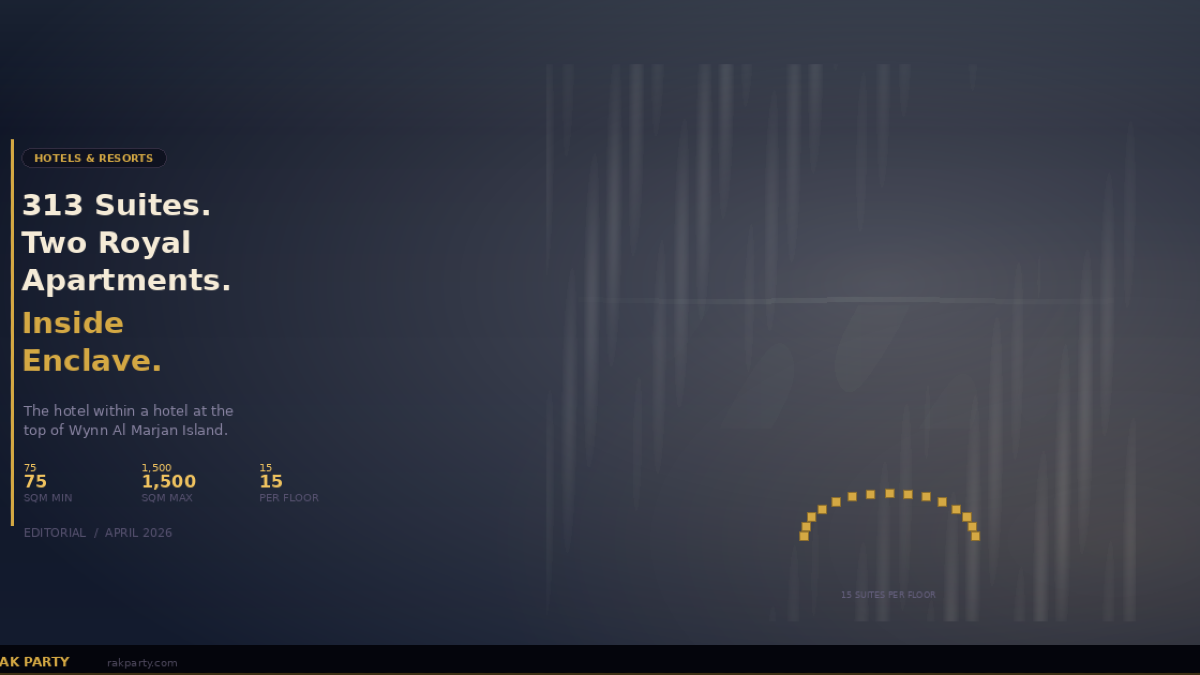
Enclave presented Lenahan with a contradiction. He needed to design a boutique hotel inside a 1,530-room resort. The guests paying for Enclave (313 suites, starting at 75 square metres, rising to 1,500 square metres for the two Royal Apartments) are paying for the opposite of what the resort rooms deliver: exclusivity, privacy, intimacy, silence. They are paying to not feel like one of 1,530.
The solution was structural separation. Enclave has its own guarded entrance. Its own lobby. Its own elevators. Its own pool complex (three pools plus a private beach on the eastern edge of the resort). Its own restaurant, where breakfast is served exclusively to Enclave guests before the space transforms for lunch and dinner into what Wynn describes as "a vibrant celebration of Lebanese cuisine" by a restaurateur making his UAE debut. Maximum 15 suites per floor. Dual pantries in every suite, stocked separately for morning and evening.
At the very top, the two Royal Apartments are the final commissions of Anouska Hempel (London) and Pinto Design (Paris), working in collaboration with WDD. Each apartment is 1,500 square metres and spans two stories. They sit at the peak of the 70-story tower with views in every direction. These are not hotel rooms being marketed as apartments. They are apartments designed by interior architects who work on private residences and superyachts, embedded inside a tower designed by a team that builds casinos. The intersection of those two design cultures, the residential and the commercial, is visible in the finishes. The 10 things nobody tells you article covers one detail that captures this: only 4% of the resort's 5.6 million square feet is casino. The other 96% is what Lenahan's team designed.
What Lenahan Has Not Revealed Yet
The September 2025 property tour was as interesting for what Lenahan withheld as for what he shared. He declined to name the London theatre company developing the Showroom's opening production. He declined to name the "entertainment industry icon from Beirut" inspiring the Delilah patron. He confirmed the Sea of Dreams show but offered no imagery or technical detail beyond its visibility from the restaurant terrace. He mentioned Indo-Persian, Italian, Lebanese, Indian, Greek, and Japanese restaurants without naming a single venue beyond Ducasse's steakhouse and Delilah.
The second resort plot adds another layer. Wynn has secured 155 acres on Al Marjan Island Three, including a 1.49 million square foot second integrated resort plot and a Janu plot for the Aman Group's lifestyle hotel brand. If the second resort proceeds, Lenahan's team will design that too. WDD's structure (200+ people, four offices, vertically integrated) was built to scale. The team that spent three years on Wynn Al Marjan Island will not need to be reassembled for a second building on the same island. They never left.
This is the long-term strategic logic behind bringing design in-house. An outsourced firm finishes and moves on. WDD stays, learns from the first building's operation, and applies that learning to the next one. Every Wynn property ever built has fed back into the design vocabulary that Lenahan's team carries forward. RAK will do the same.
The Thing About the Tower
In his UNLV oral history interview, recorded years before the RAK project was conceived, Lenahan talked about the problem of architecture firms from outside Las Vegas designing buildings for a city they did not understand. The implication was that buildings need to be designed by people who know how they will be used, who will use them, and what the place itself demands.
The 70-story tower on Al Marjan Island was not designed by a firm that flew in from London or Dubai, delivered renderings, and flew home. It was designed by a 200-person team embedded inside the company that will operate the building, led by a man who designed Steve Wynn's home, Disney's theme parks, Larry Ellison's island, and over 200 hotels on five continents before any of it. The tower is bronze because the Gulf light turns bronze at dusk. The palette is platinum and sea mist because those are the colours of the water below the windows. The guests will never see the design team's fingerprints because the fingerprints are the building itself.
That is what "veiling and revealing" means when you take it seriously.
Frequently Asked Questions
Who designed Wynn Al Marjan Island?
Todd-Avery Lenahan, President and Chief Creative Officer of Wynn Design & Development (WDD), leads the design. WDD is a 200+ person vertically integrated studio within Wynn Resorts that includes architects, interior designers, landscape architects, lighting designers, artists, and production designers across four global offices.
What is Todd-Avery Lenahan's background?
Lenahan started at Gensler, spent nearly a decade at Walt Disney Imagineering (rising to Principal of Design & Interior Architecture), founded TAL Studio in 1999, and merged it with WDD in 2019. He holds a B.Arch from the University of Texas at Austin and executive education from Harvard's Graduate School of Design. He was Boutique Design's Designer of the Year (2008) and the youngest inductee of the HD Platinum Circle (2010).
What is "veiling and revealing"?
Lenahan's design philosophy for Wynn Al Marjan Island. The resort is designed so that no single vantage point reveals the full building. Each transition (corridor, elevator, doorway) reveals a new perspective. The principle applies to everything from the processional gallery into Enclave to the positioning of restaurants along different sight lines.
How many people work on Wynn Al Marjan Island's design?
Over 200 professionals at WDD, spanning architecture, interior design, landscape, lighting, digital design, production design, construction management, and procurement. The team operates from four global offices and manages Wynn's $15 billion existing portfolio plus $10 billion in new development.
Who designed the Royal Apartments?
The two 1,500-square-metre Royal Apartments at the peak of the tower were designed by Anouska Hempel (London) and Pinto Design (Paris) in collaboration with WDD. They are described as the designers' final commissions.
Why does Wynn have its own in-house design team?
Unlike most hotel companies that outsource design to external firms, Wynn brought the capability in-house through the 2019 TAL Studio merger. The result is that the same team designs, procures, and manages every aspect of the physical experience, eliminating the translation gap between designer intent and operational reality.
What is DeRuyter Butler's role?
Butler is the chief architect of WDD, having previously collaborated on The Mirage, Bellagio, and every Wynn and Encore property. He and Lenahan jointly lead WDD.
Has Lenahan designed for other luxury brands?
Yes. Before joining Wynn full-time, his clients included Four Seasons, Mandarin Oriental, Ritz-Carlton, Auberge Resorts, Nobu Hospitality, and Larry Ellison (all resort development on the island of Lanai).