On January 19, 2026, the Ras Al Khaimah Tourism Development Authority issued a press release that landed in the inboxes of UAE business journalists and was filed under "tourism update" by most of them. The headline figure was 1.35 million overnight visitors in 2025. A 6% year-on-year increase. A 12% rise in tourism revenues. A 25% jump in MICE and weddings revenue. The kind of numbers that fit on a slide and rarely get read past the first sentence.
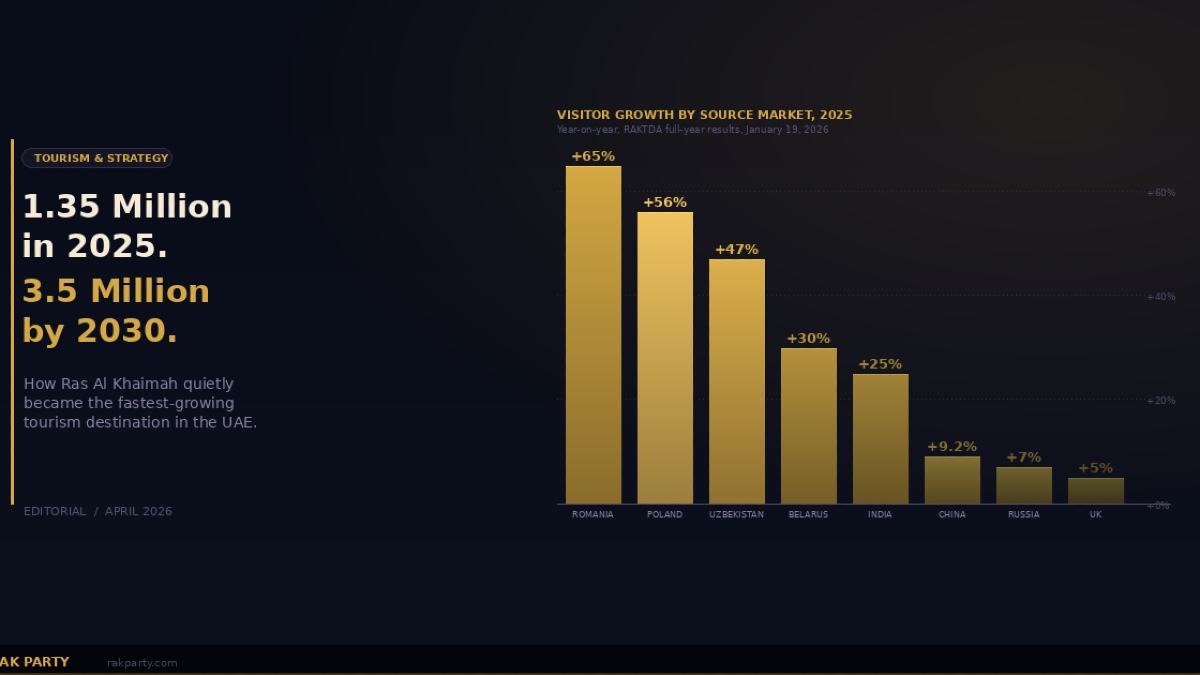
Buried in the same release was a list of source markets that should have stopped anyone reading carefully. Romania, up 65%. Poland, up 56%. Uzbekistan, up 47%. Belarus, up 30%. These are not the countries that drive Dubai's tourism economy. They are the countries Dubai has historically left on the table. RAK picked them up, opened airport routes from Warsaw, Katowice, Bucharest, Moscow, Tashkent, and Prague, watched the visitor numbers grow, and now sits on a tourism strategy that is structurally different from anything else operating in the Gulf.
This piece is about the data behind the headline, the strategy that produced it, and the Tourism Australia veteran (Phillipa Harrison, who took over RAKTDA in October 2025) who is now running the playbook. It also addresses the question that matters more than any of the figures: whether 3.5 million annual visitors by 2030, the official target, is operationally achievable from where Ras Al Khaimah sits today.
At a glance:2025 overnight visitors: 1.35 million (+6% YoY). Tourism revenue growth: 12%. MICE and weddings revenue growth: 25% full-year, 36% in H1. Fastest-growing source markets: Romania (+65%), Poland (+56%), Uzbekistan (+47%), Belarus (+30%), India (+25%). New direct flight routes: Warsaw, Katowice, Bucharest, Moscow, Tashkent, Prague. Hotels currently: 56 properties, 8,000 keys. Target by 2030: 3.5 million annual visitors and double the hotel key count. CEO: Phillipa Harrison (former MD of Tourism Australia, took role October 2025).
The Press Release Nobody Read Past the First Sentence
RAKTDA's January 19, 2026 announcement was the seventh consecutive year-end results release the authority has issued, and on the surface it followed the conventional template. Headline visitor number, year-on-year growth percentage, supporting growth figures across MICE, weddings, and revenue, hotel pipeline updates, partnership announcements, and a quote from leadership about long-term ambition. The press release format is well-rehearsed across global tourism authorities, and most journalists scan the top three numbers and move on.
What the format obscures is the underlying composition of the growth. A 6% year-on-year visitor increase to 1.35 million is, in absolute terms, an additional 70,000 overnight visitors over 2024's 1.28 million. That is a single planeload per day distributed across the year, which is a manageable operational number. But the source-market composition tells a different story. The growth was not evenly distributed. It came disproportionately from countries that have not historically been mainstream UAE tourism markets at all.
In a properly written headline, the lead figure would not have been the 1.35 million. It would have been Romania at +65%, because that is the data point that explains the strategy. The volume number tells you that RAK is growing. The source-market number tells you why.
Where the Visitors Are Actually Coming From
Across both H1 2025 and the full-year 2025 results, RAKTDA published source-market growth figures with unusual transparency. Most national or emirate-level tourism authorities aggregate by region and avoid country-level percentages. RAKTDA named names, and the names matter.
The four exceptional growth markets, all driven by direct flight expansion to Ras Al Khaimah International Airport in 2024 and 2025, were Romania at 65% year-on-year growth, Poland at 56%, Uzbekistan at 47%, and Belarus at 30%. The traditional growth markets (where increases came from established connectivity) included India at 25% (the standout among large source markets), China at 9.2%, the United Kingdom at 5%, and Russia at 7%. The CIS region as a whole and Central and Eastern Europe broadly were both reported as strong.
What this composition reveals is the structural difference between RAK's tourism strategy and Dubai's. Dubai's largest source markets in 2024 were India, Saudi Arabia, the United Kingdom, Russia, Germany, the United States, Iran, Pakistan, China, and Oman, in roughly that order. Romania, Poland, Uzbekistan, and Belarus do not appear in Dubai's top twenty. They are not strategic priorities for the larger emirate. They are exactly the markets a younger, smaller tourism authority would target if it wanted to build a visitor base that did not depend on competing with Dubai for the same audience.
The Eastern European and Central Asian source-market focus also fits RAK's product profile better than Dubai's. RAK is positioned around outdoor adventure (Jebel Jais hiking, desert safaris, the Half Marathon), beach resorts at lower price points than Dubai equivalents, and increasingly luxury hospitality through the upcoming Wynn opening. That product mix maps closely onto what affluent Eastern European and Central Asian travelers actually book when they choose Gulf destinations: a mix of accessible luxury, outdoor activity, and beach. It does not require the megacity infrastructure that Dubai sells to its own primary markets.
The Original InsightRAK is not competing with Dubai for the same visitors. The fastest-growing source markets in RAK's 2025 numbers (Romania +65%, Poland +56%, Uzbekistan +47%, Belarus +30%) are countries Dubai has historically deprioritised. RAK is building its tourism boom from a source-market portfolio that no other Gulf destination is targeting. The implication is structural: RAK is creating a different market entirely, not stealing share from a saturated one. The 3.5 million visitor target by 2030 is reachable because the addressable market that RAK is going after is not the same as the addressable market Dubai already serves.
Phillipa Harrison and the Tourism Australia Playbook
On August 25, 2025, the Government of Ras Al Khaimah announced that Phillipa Harrison would join RAKTDA as Chief Executive Officer. Harrison had ended her six-year tenure as Managing Director of Tourism Australia two days earlier, on August 23. She had been the first woman to hold the Tourism Australia MD role, appointed in September 2019, after serving as Executive General Manager International from February 2017. She took up the RAKTDA role in October 2025.
The choice signals what kind of strategy RAK is intending to run. Tourism Australia is one of the most operationally sophisticated national tourism authorities in the world, known for long-horizon market development, brand-led campaigns (the "Come and Say G'day" series), and strategic source-market diversification. Harrison led Tourism Australia through the post-pandemic recovery, a period that required Australia to rebuild international visitor confidence after one of the world's most prolonged border closures. The recovery playbook she developed there (focusing on aspirational brand positioning, premium and high-value visitor segments, and direct relationships with global travel networks) maps directly onto what RAK is doing now.
Sheikh Ahmed bin Saud Al Qasimi, Chairman of RAKTDA's Executive Committee, framed the appointment in straightforward terms when it was announced. "Tourism is at the heart of Ras Al Khaimah's strategy, it is our fastest-growing sector and we've achieved remarkable milestones in a short period of time," he said. "Ms Harrison brings with her a depth of knowledge and leadership experience, most recently with Tourism Australia, that gives us confidence in her ability to align with Ras Al Khaimah's ambitious goals and strategic targets in the tourism sector."
Harrison's own statement on taking the role was characteristically restrained. "I'm honoured to join at such an exciting time," she said. "Ras Al Khaimah has already established itself as an international success story, and I look forward to unlocking even more growth in the years ahead." Her predecessor, Raki Phillips, who led RAKTDA through the explosive 2020-2025 growth phase, moved to Accor as the head of the French hospitality group's Premium, Midscale and Economy division for the Middle East and Africa. The succession was orderly, the strategic continuity was visible, and the appointment of a Tourism Australia veteran signalled that RAK intends to run a more globally sophisticated playbook from here forward.
The Airport Routes That Made the Source Markets Possible
Tourism growth from a previously deprioritised source market is effectively impossible without direct air connectivity. A traveler from Bucharest who has to connect through Istanbul, Doha, or Dubai to reach Ras Al Khaimah will choose Antalya or Hurghada instead. The economics and the time cost decide it. RAK's 2025 source-market growth from Romania, Poland, Uzbekistan, Belarus, and the Czech Republic was directly enabled by Ras Al Khaimah International Airport adding new direct routes during the year.
The new direct connections added across 2024 and 2025 included Warsaw and Katowice (Poland), Bucharest (Romania), Moscow (Russia), Tashkent (Uzbekistan), and Prague (Czech Republic). Each of these routes was negotiated with carriers willing to test demand from a smaller emirate's airport against the gravitational pull of Dubai International, which sits roughly 50 minutes away by road. The fact that these routes are operating profitably enough to continue is itself the proof point. Direct routes that do not generate sustainable load factors get cut. RAK International's routes are not getting cut. They are expanding.
The airport itself is also expanding capacity. RAKTDA confirmed plans for a LEED Gold-targeted VIP terminal at Ras Al Khaimah International Airport set to open in 2027, designed to handle the high-value visitor segment that the Wynn opening and the broader luxury positioning require. A VIP terminal is not the same investment as a general capacity expansion. It signals that the airport's expansion strategy is segmented around the same kind of guest the resorts are being built for.
The Hotel Pipeline: Doubling Keys by 2030
In 2024, RAK had 56 hotels and approximately 8,000 hotel keys. The 2030 target, made explicit by RAKTDA in multiple recent communications, is to double the key count. That requires roughly 8,000 additional rooms across new openings between now and 2030, which is a serious pipeline commitment. RAK is not relying on the hope that Wynn alone will absorb the demand growth. The emirate is building accommodation infrastructure at a pace that matches the visitor target.
The 2025 openings included Rove Al Marjan Island (a homegrown UAE lifestyle brand at the more accessible price point) and SO/ Ras Al Khaimah (under Accor's lifestyle luxury portfolio). The pipeline of confirmed announced future openings includes Janu Al Marjan Island (Aman Group's sister brand, opening late 2028), Four Seasons, Fairmont, Taj, NH Collection (Minor Hotels), Nobu, and W Hotels. That brand mix matters. It spans accessible lifestyle (Rove, NH Collection), premium midscale (Fairmont), upper luxury (Four Seasons, Taj, Janu), and lifestyle luxury (W, Nobu, SO/). The hotel inventory near Wynn Al Marjan Island is expanding across every meaningful price tier.
For investors evaluating real estate, the implication is that Al Marjan Island and the broader RAK property market is not a one-resort bet. The hotel pipeline behind Wynn is institutional, branded, and diversified across operating models. That kind of pipeline does not develop without underlying demand projections that the developers and operators are willing to commit capital against.
The Luxury Network Membership That Validates the Strategy
In 2025, Ras Al Khaimah joined two travel networks that almost no other tourism destination in the Gulf has accessed: Virtuoso and Serandipians by Traveller Made. Both are invitation-only luxury travel networks, and membership is the closest thing the global luxury travel trade has to formal accreditation.
Virtuoso is the world's largest luxury travel agent network, with over 1,300 member agencies and a portfolio of more than 2,300 preferred travel partners. Membership for a destination means that Virtuoso-affiliated luxury travel advisors actively recommend and book the destination, with preferred rates, amenity packages, and direct supplier relationships. Serandipians by Traveller Made operates similarly at a slightly more curated level, with around 600 member agencies focused exclusively on bespoke high-end travel. A destination joining both is rare. A destination joining both in the same year, before its flagship luxury property has even opened, is unusual.
What this signals is that the luxury travel trade is treating RAK as a pre-validated luxury destination rather than waiting for Wynn to open before extending recognition. The infrastructure of luxury travel sales is being built in parallel with the destination's physical infrastructure, not after it. By the time Wynn opens in spring 2027, the global network of luxury travel advisors will already have RAK in its preferred-destination database with established commercial relationships in place. That kind of pre-positioning is what professional tourism authorities do, and it is the part of the playbook that requires a CEO with Harrison's network to execute.
Wynn and the 2027 Inflection Point
All of the data so far has been pre-Wynn. The 1.35 million 2025 visitor number, the 25% MICE growth, the source-market diversification, the luxury network memberships were all achieved with the $5.1 billion Wynn Al Marjan Island resort still under construction. The resort opens in spring 2027 with 1,530 rooms and the UAE's first casino, and it is the inflection point that the entire current strategy is positioned around.
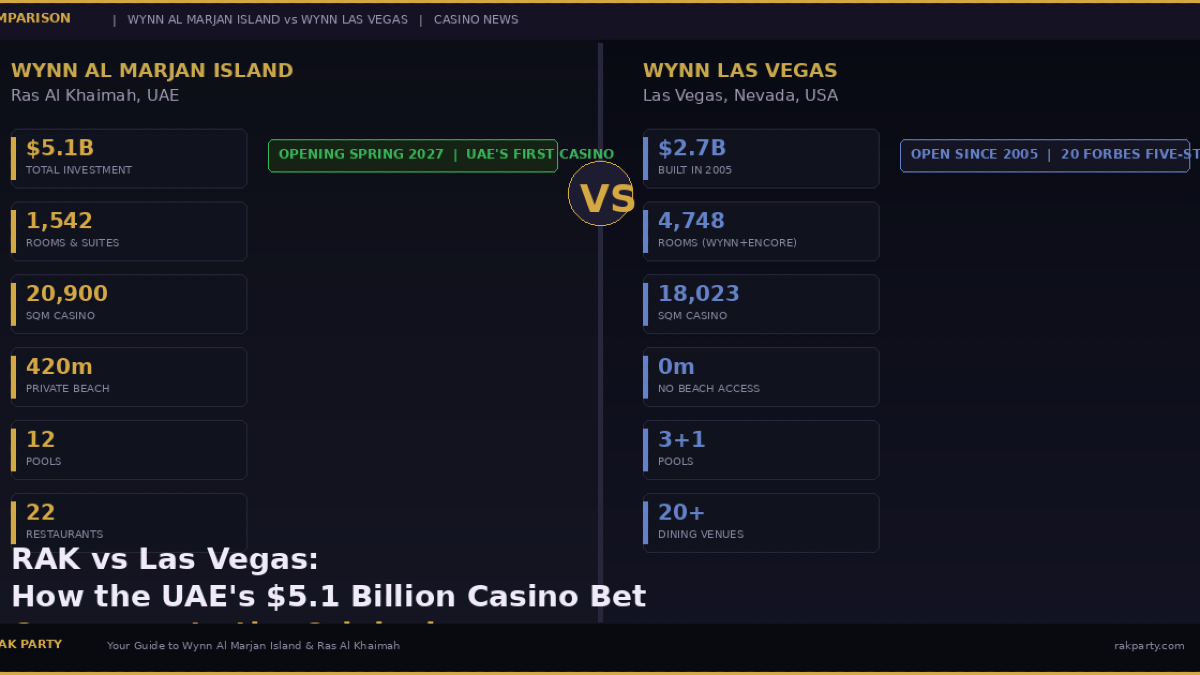
To put the inflection in proportion: Wynn's main casino floor alone (224,000 square feet) is larger than the casino at Wynn Las Vegas. Wynn Resorts CEO Craig Billings, speaking to CNBC's Jim Cramer in March 2025, said analysts have projected Wynn Al Marjan Island gaming revenue "in the $5 billion to $8 billion range," comparable to the Las Vegas Strip's annual revenue of just over $6 billion. That is a single-property revenue projection inside an emirate that currently generates a fraction of Dubai's tourism revenue across all categories combined. The gap between RAK's current scale and Wynn's projected scale is the gap that the current 3.5 million visitor target is designed to close.
The calculation behind the 3.5 million target works out cleanly: RAK currently runs at approximately 1.35 million annual overnight visitors with 8,000 hotel keys. To absorb Wynn's projected demand at planned occupancy rates, plus the additional demand from the broader hotel pipeline opening between 2026 and 2030, the emirate needs to roughly triple its current visitor count. That is what 3.5 million by 2030 actually means. It is not an aspirational round number. It is the operational requirement that Wynn and the surrounding pipeline imply. The second Wynn resort already in planning extends the demand-absorption requirement further still.
What 3.5 Million Visitors by 2030 Actually Requires
Tripling visitor numbers in five years is not impossible, but it requires every part of the infrastructure stack to scale simultaneously. The hotel pipeline addresses accommodation. The airport route expansion addresses connectivity. The luxury network memberships address sales channels. The Wynn opening addresses headline demand generation. What remains underdeveloped, and what Harrison's tenure will likely focus on, is the medium-term marketing and brand strategy that converts the operational capability into actual sustained bookings.
There are also macro factors outside RAKTDA's control. Geopolitical stability in the broader Middle East affects all UAE tourism numbers. Currency movements in source markets (especially CIS and Eastern Europe) influence whether the new direct routes remain commercially viable. Global economic conditions affect luxury and MICE travel disproportionately. None of these can be addressed by tourism strategy alone, but all of them will shape whether RAK hits 3.5 million in 2030 or 2032 or 2033. The current trajectory, based on the 2025 numbers, is consistent with the lower end of that range, which is a reasonable execution position to be in three years before the target year. Visitors arriving on the new direct routes will find a deepening list of things to do across the emirate, from Jebel Jais to the desert safari operators that have been part of the pre-Wynn growth story.
For travelers and investors trying to read the data, the practical implication is simple. RAK is not a Dubai-substitute play. It is a parallel-market play, with a different source-market portfolio, a different hospitality product mix, and a different geographic positioning. How RAK actually compares to Dubai for visitors choosing between them is a useful framing for individual travel decisions. But for a destination evaluation framework, the more accurate comparison is RAK to other emerging luxury destinations (Saudi's Red Sea project, Oman's broader tourism program) than to Dubai itself.
Frequently Asked Questions
How many visitors did Ras Al Khaimah receive in 2025?
1.35 million overnight visitors, a 6% year-on-year increase from 1.28 million in 2024. Tourism revenue grew 12%. MICE and weddings revenue grew 25% for the full year (36% in H1 2025).
What is RAK's 2030 visitor target?
Over 3.5 million annual overnight visitors. The target was confirmed in RAKTDA's January 2026 results release and has been a consistent strategic objective since at least 2023.
Who is the current CEO of RAKTDA?
Phillipa Harrison, who took the role in October 2025 after six years as Managing Director of Tourism Australia. She was the first woman to hold the Tourism Australia MD role, appointed in 2019.
What happened to the previous CEO?
Raki Phillips led RAKTDA from 2018 through August 2025 and then moved to Accor as the head of the French hospitality group's Premium, Midscale and Economy division for the Middle East and Africa.
Which source markets are growing fastest?
Romania (+65% year-on-year in 2025), Poland (+56%), Uzbekistan (+47%), and Belarus (+30%). Among larger established markets, India led with +25%, followed by China (+9.2%), Russia (+7%), and the United Kingdom (+5%).
Why is RAK growing from these specific markets and not others?
Direct flight connectivity. Ras Al Khaimah International Airport added new direct routes from Warsaw, Katowice, Bucharest, Moscow, Tashkent, and Prague during 2024 and 2025. Tourism growth from a previously deprioritised source market is structurally dependent on direct air access.
How does RAK's tourism strategy differ from Dubai's?
RAK is targeting source markets that Dubai has historically deprioritised. Romania, Poland, Uzbekistan, and Belarus do not appear in Dubai's top twenty source markets. RAK's product mix (outdoor adventure, accessible beach resorts, emerging luxury) also differs from Dubai's megacity infrastructure. RAK is a parallel-market play, not a substitution play.
How many hotels does RAK currently have?
Approximately 56 hotels and 8,000 hotel keys as of the end of 2024. The 2030 target is to double the key count, which requires approximately 8,000 additional rooms in the pipeline by 2030.
What new hotels are confirmed for RAK?
Confirmed pipeline includes Janu Al Marjan Island (Aman Group sister brand, late 2028), Four Seasons, Fairmont, Taj, NH Collection (Minor Hotels), Nobu, and W Hotels. Rove Al Marjan Island and SO/ Ras Al Khaimah opened in 2025.
What role does Wynn Al Marjan Island play in the strategy?
Wynn is the demand inflection point. The 1,530-room resort opens in spring 2027 with the UAE's first casino. Analysts have projected gaming revenue of $5-8 billion annually, comparable to the Las Vegas Strip's $6 billion. The 3.5 million visitor target is the operational requirement that the Wynn opening and the broader hotel pipeline imply.
Has RAK joined any global luxury travel networks?
Yes. In 2025, RAK joined Virtuoso (the world's largest luxury travel agent network, 1,300+ member agencies) and Serandipians by Traveller Made (around 600 member agencies focused on bespoke high-end travel). Both are invitation-only and represent formal recognition by the global luxury travel trade.
On January 19, 2026, RAKTDA published a press release that most journalists read for the headline figure and filed away. The headline figure was 1.35 million overnight visitors. The story underneath the headline was Romania at 65%, Poland at 56%, Uzbekistan at 47%, and a Tourism Australia veteran running a strategy that nobody else in the Gulf is running. By spring 2027, when Wynn Al Marjan Island opens, the strategy will face its real test. The visitor target is 3.5 million by 2030. The current trajectory says it is reachable. The source-market portfolio says it is reachable from a different starting point than anyone expected. RAK is not becoming the next Dubai. It is becoming the first version of itself.