A desert safari in Ras Al Khaimah is the experience that most visitors remember longest. Not the hotel pool. Not the beach. The desert. There is something about sitting on a dune at sunset, watching the sky turn amber over sand that stretches to the Hajar Mountains, that resets your sense of scale. The UAE has dozens of desert safari operators across multiple emirates, but RAK's version is different from what you will find in Dubai, and understanding that difference is the key to choosing the right one.
RAK's safari scene operates primarily in the Awafi desert region, south of the city. The dunes here are less trafficked than Dubai's Al Awir circuit, the camps are smaller, and the experience feels closer to what the Bedouin desert actually looked like before tourism reshaped it. As TheBetterVacation put it in their 2026 guide: "Ras Al Khaimah's desert landscape is less commercialised and more intimate than the busier Dubai safari scene." That is accurate. If you have done a Dubai desert safari and found it crowded, overproduced, or too much like a theme park with sand, RAK is the correction.
This guide covers every format (morning, evening, overnight, private), real pricing from multiple sources, the seasonal considerations that genuinely matter (summer safaris can be dangerous, and too few guides say this plainly), family logistics, the RAK vs Dubai comparison with honest trade-offs, and the practical details that determine whether your experience is memorable or mediocre. If you are planning a trip around the Wynn Al Marjan Island opening in 2027, a desert safari is the single best activity to pair with a resort stay on the coast.
What a Desert Safari in RAK Actually Costs: 2026 Pricing
Pricing varies significantly by format, group size, and operator. Here is a cross-referenced breakdown from GetYourGuide, Viator, Cobone, Rayna Tours, and the RAK-based operators who run the camps directly.
Safari Format | Adult Price (AED) | Child Price (AED) | Duration | What's Included
Evening safari + BBQ dinner (shared group) | 200 - 364 | 150 - 357 (ages 4-11) | 6-7 hours (3pm-10pm) | Hotel pickup, dune bashing, sandboarding, camel ride, BBQ dinner, cultural shows (belly dance, Tanura, fire show), henna painting, hotel drop-off
Budget evening safari | 85 - 150 | Similar or free (under 4) | 4-5 hours | Reduced inclusions; may exclude some activities or use basic camp
Overnight premium chalet camping | 500 | 150 (ages 4-11) | Afternoon to next morning | Everything in evening safari + overnight chalet stay, bonfire, sunrise viewing, breakfast, camp overnight with private facilities
Private evening safari (exclusive vehicle) | 600 - 1,200 per group | Included in group price | 6-7 hours | Private 4x4, dedicated guide, flexible schedule, private camp seating, upgraded BBQ, all activities
Morning desert drive | 150 - 250 | 100 - 150 | 3-4 hours | Sunrise or early morning dune drive, sandboarding, photo stops, no dinner/shows
Quad biking (standalone) | 150 - 350 | Not available (18+ only) | 30-60 minutes | Guided quad bike ride through desert terrain, safety briefing, equipment
Dune buggy (standalone) | 250 - 500 | Varies (passenger only for under 18) | 30-60 minutes | Guided buggy ride, safety equipment, instructor
Hot air balloon (RAK) | From AED 800+ | Varies | 60-90 minutes flight | Sunrise flight over desert/mountains, post-flight breakfast, certificate
Sources: GetYourGuide, Viator, TheBetterVacation, Cobone, Rayna Tours, rasalkhaimahdesertsafari.com, desertsafarirasalkhaimah.com. Prices include 5% VAT. Prices fluctuate seasonally; peak season (November through March) commands higher rates and faster sell-outs.
Price Reality CheckThe AED 85 "desert safari" listings on deal sites like Cobone are real, but they are stripped-down experiences: shorter dune bashing, basic camp facilities, and fewer activities. The AED 364 price point from GetYourGuide represents the full-service evening experience with a quality BBQ dinner, cultural shows, and hotel transfers. If this is your one desert experience during a RAK trip, the AED 300 to 400 range delivers the version you will actually want to remember.
What Actually Happens on a Desert Safari: Hour by Hour
The most popular format is the evening desert safari, which runs from approximately 3pm to 10pm. Here is what a typical seven-hour experience looks like, based on operator descriptions, TripAdvisor reviews, and first-hand accounts:
3:00 PM: Hotel Pickup
A 4x4 Land Cruiser picks you up from your RAK hotel (most operators cover hotels on Al Marjan Island, Al Hamra, and RAK city center; pickups from Dubai or Sharjah cost extra or require a different package). The drive to the Awafi desert takes 20 to 40 minutes depending on your hotel location. Some operators deflate the tires en route, which is standard practice for sand driving.
3:30 - 4:15 PM: Dune Bashing
This is the heart of the safari. Your driver takes the Land Cruiser across the dunes at speed, climbing and dropping over ridges in a controlled but adrenaline-heavy sequence. The ride lasts 20 to 45 minutes depending on the operator and package. RAK dune bashing is generally less intense than the Lahbab red dune circuit in Dubai (the dunes are not as tall), but it is more than enough for most visitors. TripAdvisor reviews consistently name the driver as the factor that makes or breaks this segment. One reviewer noted: "Our driver Salim was amazing, he took us up some really steep dunes showing off his great driving skills." Motion sickness is a real possibility. Sit in the front seat if you are prone to it, and avoid eating heavily beforehand.
4:15 - 5:30 PM: Activities at the Dunes and Photo Stop
After dune bashing, the vehicle stops at a high point for sunset photos. The light over the Awafi dunes between 4:30 and 5:30 pm (in winter months) is exceptional for photography. Many operators offer sandboarding on the slopes (think snowboarding, but on sand, and slower). This is included in most packages.
5:30 - 7:00 PM: Bedouin Camp Activities
The camp is where RAK's smaller-scale advantage becomes most apparent. Dubai camps can serve 200+ guests per evening in partitioned sections. RAK camps are typically smaller, with fewer groups, more direct attention from staff, and a less factory-line feel. Standard camp activities include camel riding (short circuit, 5 to 10 minutes), henna painting, falconry demonstrations, shisha smoking (optional), and dressing in traditional Arabian clothing for photos. Children can participate in all of these except shisha.
7:00 - 9:00 PM: Dinner and Shows
The BBQ dinner is an open-air buffet with grilled meats (lamb, chicken, kebabs), salads, hummus, Arabic bread, rice, and desserts. Vegetarian options are available if requested in advance. Several reviewers specifically praised the food quality: "The BBQ dinner in Ras Al Khaimah desert was delicious" (TripAdvisor). The entertainment runs during and after dinner: belly dancing, Tanura spinning (a Sufi-inspired whirling dance), fire shows, and sometimes Khaleeji and Dabke folk dance performances. The quality of performers varies by operator and night, but TripAdvisor reviews are overwhelmingly positive (4.5+ star average on the top RAK operators).
9:00 - 10:00 PM: Drop-off
The return drive to your hotel takes 20 to 40 minutes. For the overnight chalet option, you skip the drop-off and instead settle into a desert chalet for the night, with a bonfire, stargazing, and breakfast the following morning.
RAK vs Dubai Desert Safari: An Honest Comparison
This is the question that every Dubai-based visitor and every tourist deciding between emirates will ask. Here is the answer, without the marketing spin.
Factor | RAK Desert Safari | Dubai Desert Safari
Crowd level | Smaller camps, fewer tourists per session. More intimate, quieter. | Large operations serving 200+ guests. Multiple tour buses. More commercial.
Dune terrain | Awafi desert. Moderate dunes, golden/red-tinted sand. Less extreme than Lahbab. | Al Awir (standard, gentle). Lahbab (red dunes, steeper, more intense). More variety.
Price range | AED 85 - 500+ (evening to overnight) | AED 100 - 800+ (standard to VIP/private)
Authenticity feel | Closer to traditional Bedouin experience. Less polished but more genuine. | More produced, higher-end camps available. Can feel manufactured at lower price points.
Pickup from Dubai hotels | Available but adds 45-60 min each way. Extra cost on some packages. | Standard. Most operators include free Dubai hotel pickup.
Best for | Visitors already staying in RAK. People who want intimacy over spectacle. Families. | Visitors staying in Dubai. People who want maximum variety of operators and formats.
Motion sickness risk | Moderate (gentler dunes) | Higher at Lahbab red dunes (steeper terrain, longer bashing sessions)
Overnight option | Yes. Premium chalets at Bedouin Oasis Camp (AED 500/adult). | Yes. Multiple operators offer tent/chalet options (AED 400-1,500+).
Bottom line: if you are staying in Ras Al Khaimah (perhaps visiting the Wynn resort, the Jebel Jais zipline, or Al Marjan Island), book the RAK safari. You will spend your time in the desert rather than on the highway. If you are staying in Dubai and only have one evening, the Dubai version saves you 90 minutes of driving each way. The RAK vs Dubai comparison guide covers this dynamic across all activity categories.
When to Go: Seasonal Advice That Most Guides Skip
This section exists because most safari guides bury or ignore the single most important variable: temperature. The difference between a December safari and a July safari is the difference between a memory you cherish and a genuine health risk.
Season | Months | Desert Temp (Day) | Safari Rating | Notes
Peak (best) | November - February | 22 - 28°C | Excellent | Perfect conditions. Book 48-72 hours ahead on weekends. Cool evenings require a light jacket.
Shoulder | March - April, October | 28 - 35°C | Good | Still comfortable. Warmer but manageable. March/April may coincide with Ramadan (check dates).
Hot | May, September | 35 - 40°C | Proceed with caution | Operators shift to evening-only. Hydration critical. Not recommended for children or elderly.
Extreme | June - August | 40 - 45°C+ | Avoid if possible | RAKTDA describes this as "not the best season to enjoy outdoor experiences." Heat exhaustion risk is real. Some operators reduce or pause daytime safaris. If you must go, evening only, and carry minimum 2L water per person.
The month-by-month RAK visitor guide has the detailed temperature tables, event calendars, and crowd-level analysis for planning your trip around optimal conditions.
Bringing Kids: Family Logistics and Age Restrictions
Desert safaris in RAK are genuinely family-friendly, but there are specific restrictions that operators do not always make clear upfront.
Children aged 4 to 11 are welcome on all standard safaris. They can participate in camel riding, sandboarding, henna painting, falcon holding, and all cultural performances. Child pricing (typically AED 150 to 357) applies. Children sit in the same vehicle during dune bashing.
Children under 4 require a private vehicle booking on most operators. They cannot be accommodated in shared group vehicles due to the intensity of dune bashing. This means you are looking at the private safari price tier (AED 600 to 1,200 per group) rather than the shared per-person rate. Some operators allow infants if the parent signs a waiver, but this varies.
Quad biking is restricted to ages 18 and above (Rayna Tours policy, and standard across most operators). Dune buggies allow younger passengers but not drivers.
Pregnant women and guests with serious back, neck, or heart conditions are generally advised against dune bashing. Rayna Tours explicitly states: "pregnant ladies, individuals with heart problems, and those with other sensitive ailments will not be permitted to partake in this activity." This is a safety policy, not a suggestion.
Five Mistakes First-Time Safari Visitors Make
1. Booking the cheapest listing without reading what's excluded. The AED 85 deals on Cobone and similar platforms are real, but they often exclude specific activities, use basic camps, or have shorter dune bashing sessions. Read the inclusions list before booking. If it does not specifically mention BBQ dinner, cultural shows, and hotel transfer, you are getting a stripped version.
2. Going in summer without understanding the heat. June through August desert temperatures exceed 40°C. This is not uncomfortable; it is medically dangerous for prolonged outdoor exposure. If you visit RAK in summer, choose an evening safari that starts after 4pm and carry significantly more water than you think you need.
3. Eating a large meal before dune bashing. Motion sickness during dune bashing is common enough that it appears in multiple TripAdvisor reviews. Eat lightly beforehand. The BBQ dinner comes after the driving portion, which is intentional.
4. Not confirming the pickup location for RAK-specific hotels. Many safari operators list "Dubai pickup included" as default. If you are staying on Al Marjan Island, in Al Hamra, or in RAK city, confirm that the operator serves your specific hotel. Some Dubai-centric operators charge extra for RAK collection or do not cover it at all.
5. Wearing closed-toe shoes. This sounds counterintuitive (most outdoor activity guides recommend closed shoes), but for desert sand, sandals or flip-flops are actually easier. Closed shoes fill with sand immediately. The exception is quad biking, where closed-toe shoes are required for safety.
What to Wear and Pack
Light, breathable clothing in natural fabrics (cotton or linen). Light colors reflect heat. Long sleeves protect from sand and sun without adding heat if the fabric is loose. Sandals or flip-flops for camp and dune walking; closed shoes only if you are doing quad biking. Sunglasses and a wide-brimmed hat are non-negotiable. Sunscreen (SPF 50+) applied before departure. A light jacket or shawl for after sunset (desert temperatures can drop 10 to 15 degrees after dark in winter months). Phone or camera in a sealed bag or zip-pocket to keep sand out. Cash for optional extras (quad biking, shisha, photos in traditional dress). And at least 1.5 litres of water per person, even if the operator says water is included.
Frequently Asked Questions
How much does a desert safari in Ras Al Khaimah cost?
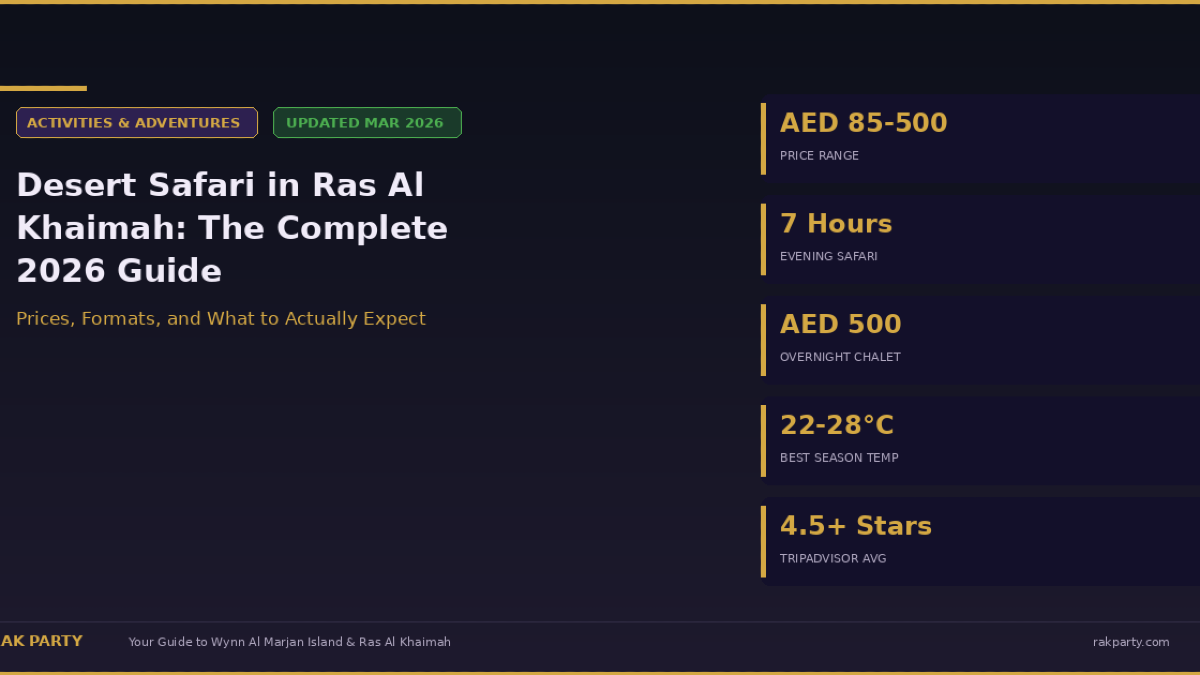
An evening desert safari with BBQ dinner, dune bashing, and hotel transfer costs AED 200 to 364 per adult. Budget options start from AED 85. Overnight premium chalet camping costs AED 500 per adult. Private safaris range from AED 600 to 1,200 per group. Quad biking is AED 150 to 350 (18+ only).
How long does a RAK desert safari take?
The standard evening safari runs approximately 7 hours (3pm to 10pm). Morning desert drives take 3 to 4 hours. The overnight chalet experience runs from afternoon to the following morning.
Are children allowed on desert safaris in RAK?
Children aged 4 to 11 are welcome on all standard shared safaris, with child-specific pricing. Children under 4 typically require a private vehicle booking. Quad biking is restricted to 18+. All camp activities (camel riding, henna, sandboarding) are child-friendly.
Is the RAK desert safari different from Dubai's?
Yes. RAK safaris operate in the Awafi desert, which is less commercialized and more intimate than Dubai's Al Awir or Lahbab circuits. Camps are smaller, group sizes are lower, and the experience feels more authentic. The trade-off: Dubai offers more operator variety and steeper dunes at Lahbab.
What is the best time of year for a desert safari in RAK?
November through February is ideal (22 to 28 degrees Celsius). March, April, and October are good shoulder months. Avoid June through August if possible (40 degrees and above). RAKTDA describes summer as "not the best season to enjoy outdoor experiences."
Can I book a desert safari from my hotel on Al Marjan Island?
Yes. Most RAK-based operators include pickup from Al Marjan Island, Al Hamra, and RAK city center hotels. Confirm your specific hotel with the operator before booking. Dubai-based operators may charge extra for RAK collection.
What should I wear to a desert safari?
Light, breathable clothing in natural fabrics. Sandals or flip-flops for camp (closed shoes for quad biking only). Sunglasses, sunhat, and SPF 50+ sunscreen. Bring a light jacket for cool desert evenings (winter months).
Is vegetarian food available at desert safari BBQ dinners?
Yes. All reputable operators provide vegetarian options alongside grilled meats, salads, hummus, and Arabic bread. Inform the operator of any dietary requirements (vegan, halal-specific, allergies) at the time of booking.
Can I combine a desert safari with other RAK activities?
Absolutely. The most popular combinations are desert safari + Jebel Jais zipline (separate day recommended) or desert safari + beach day on Al Marjan Island. The complete guide to things to do in RAK maps out multi-day itineraries.
Is dune bashing safe?
Yes, when operated by licensed, experienced drivers. All vehicles carry safety equipment. However, dune bashing is not recommended for pregnant women, individuals with serious back/neck conditions, or those with heart problems. Motion sickness is possible; sit in the front seat and avoid heavy meals beforehand.
Pairing a Desert Safari with Your RAK Trip
A desert safari works as both a standalone half-day experience and as part of a multi-day RAK itinerary. For visitors coming to the emirate ahead of or during the Wynn Al Marjan Island resort opening, the pairing is natural: world-class resort on the coast, authentic desert experience inland. The contrast is what makes RAK distinct from Dubai as a destination.
The complete Things to Do guide covers every activity in the emirate, from Jebel Jais to kayaking the mangroves. The tourist places near Wynn maps attractions specifically within reach of Al Marjan Island. And the transport guide from Dubai covers every route for visitors making the drive from DXB.
Desert safari operators, tour companies, and adventure tourism businesses looking to reach RAK visitors can explore advertising options at rakparty.com/advertise. Stay updated on RAK guides and Wynn developments by subscribing to the newsletter at rakparty.com.