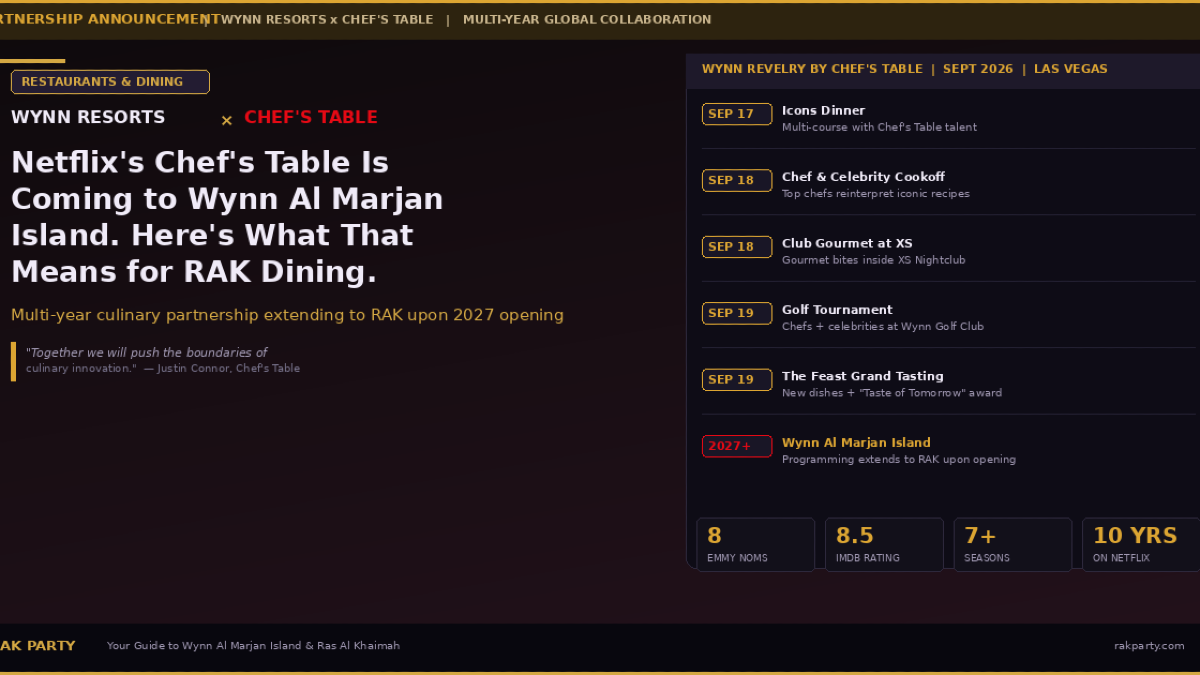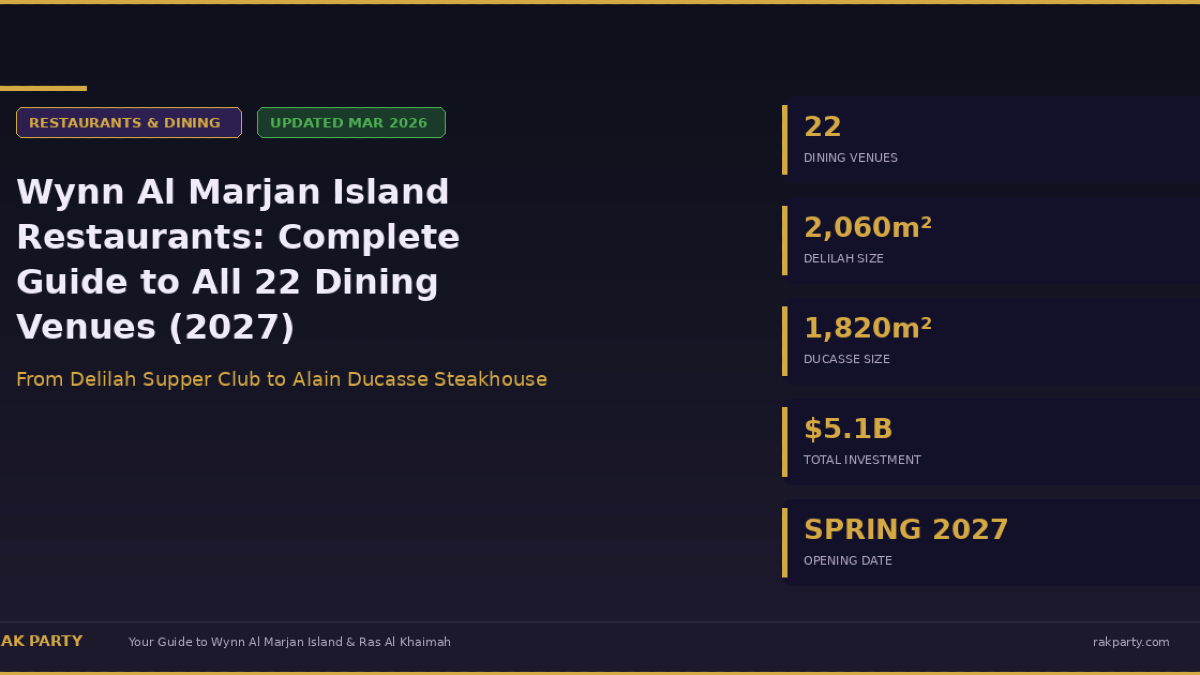
On September 25, 2025, The National's food correspondent filed a report from a Wynn Las Vegas property tour where Todd-Avery Lenahan, president and chief creative officer of Wynn Design & Development, had just confirmed the first two restaurants for the Ras Al Khaimah property opening in spring 2027. One was a two-floor, 1,820-square-metre French-American steakhouse by Alain Ducasse, who called the project "one of the most visionary and ambitious in the region." The other was Delilah.
Delilah is the 1950s-themed supper club that has operated at Wynn Las Vegas since 2021, West Hollywood since 2018, and Miami since 2023. It runs under a strict no-photo policy. It stages nightly live performances. It operates one of the hardest reservations to secure on the Las Vegas Strip. And it was about to cross a threshold that it had never crossed in its operating history: its first venue outside the United States. The announcement named beef Wellington and chicken tenders as menu carryovers. It confirmed nightly live performances. It revealed that Delilah at Wynn Al Marjan Island would occupy 2,060 square metres on the resort's first floor, making it approximately twice the footprint of the Las Vegas flagship.
And then Lenahan added one detail that changed the entire proposition. In Las Vegas, Delilah's fictional patron is a 1950s showgirl inspired by the likes of Rita Hayworth and Lucille Ball. In RAK, Lenahan said during the property tour, the patron will be "inspired by an entertainment industry icon from Beirut." The name stays. The performance tradition stays. The no-photo policy stays. The character shifts from American midcentury to Lebanese midcentury. From Hollywood to Beirut.
At a glance:Venue: Delilah at Wynn Al Marjan Island. Location: first floor of the resort, approximately 2,060 square metres (22,173 sq ft). Status: first international outpost (outside the United States). Existing locations: Wynn Las Vegas (since 2021), West Hollywood (since 2018), Miami (since 2023). Operator partnership: The h.wood Group (co-founders Brian Toll and John Terzian). Design: Wynn Design & Development under Todd-Avery Lenahan. Fictional patron: shifting from a 1950s American showgirl to "an entertainment industry icon from Beirut." Key policies: no-photo policy, nightly live music and performances. Menu carryovers: beef Wellington, chicken tenders, plus new items highlighting regional ingredients. Design references: El Morocco (New York), Maxim's (Paris), Les Caves Du Roy (Beirut). Opening: spring 2027.
What Delilah Actually Is in Las Vegas, West Hollywood, and Miami
Delilah is not a restaurant in the conventional sense. It is a supper club, a format that dates to the 1920s and 1930s and that combines dinner service with live entertainment in a single seated experience. The guest arrives, orders dinner, eats, drinks, and watches performances without leaving the table. The food is part of the show. The show is part of the meal. The format died in most American cities by the 1970s, killed by nightclubs on one side and fine dining on the other. The h.wood Group revived it in 2018 with Delilah in West Hollywood, and the concept succeeded because it offered something that neither nightclubs nor fine-dining restaurants provide: a complete evening in a single room, with a narrative and a character holding the experience together.
The character in question is Delilah herself. She is not a real person. She is a fictional patron, the woman the venue is named for, whose taste and personality govern the interior design, the music selection, the performance style, and the dress code. In Las Vegas, Delilah is a 1950s American showgirl inspired by Rita Hayworth, Lucille Ball, and the glamour of midcentury Hollywood. The decor evokes a private apartment belonging to a woman of considerable style and independent means. The lighting is low. The furniture is residential. The performances are intimate (small groups, vocalists, instrumentalists, dancers at close range). The no-photo policy reinforces the fiction: you are inside someone's home for the evening, and you would not photograph a dinner party at a friend's house.
The menu is intentionally generous rather than pretentious. Beef Wellington (the signature dish, served tableside) and chicken tenders (which became an ironic cult favourite on the Las Vegas Strip) sit alongside a rotating cocktail programme and a wine list that favours accessible Californian and French bottles over rare-cellar depth. Delilah is not trying to compete with Alain Ducasse for culinary prestige. It is trying to be the place you go after dinner at Ducasse, or instead of dinner at Ducasse, depending on whether you want food as art or food as atmosphere.
The Beirut-Inspired Patron: Localising the Fiction
The single most important creative decision Wynn has announced for the RAK Delilah is the shift in its fictional patron. Lenahan, speaking during a property tour at the Las Vegas venue, said that the UAE's Delilah patron will be "inspired by an entertainment industry icon from Beirut." He did not name the specific icon. He did not describe the patron's biography or visual identity. But the geographic shift tells the creative story.
Beirut in the 1950s and 1960s was the entertainment capital of the Arab world. The city's Casino du Liban (built in 1959 in Jounieh, 20 kilometres north of central Beirut) hosted Ella Fitzgerald, Dalida, Sabah, and Fairuz. Its nightclub scene ran from the Phoenicia Hotel's rooftop to the cabarets of Hamra Street. The women who defined Beirut's midcentury entertainment industry (Sabah, Samia Gamal, Nadia Gamal, Hind Rostom in the broader Levantine-Egyptian circuit) occupied the same cultural space as Rita Hayworth and Lucille Ball: they were performers, socialites, and cultural avatars whose personal style defined what glamour looked like in their region.
By shifting the patron from Hollywood to Beirut, Lenahan is not transplanting an American concept into the Gulf. He is regrounding the concept in the cultural geography where it will actually operate. A supper club in Ras Al Khaimah whose patron is an American showgirl from the 1950s would be a themed import, a franchise. A supper club whose patron is a Beirut entertainment icon from the same era is a cultural reinterpretation, the venue finding its own fictional lineage in the region where its guests live and travel. This is the same reverse-Orientalism principle that governs the Living Gallery elsewhere in the resort, where the art collection places Eastern and Middle Eastern works at the centre of the curatorial thesis rather than at the margins of a Western collection. The direction of cultural flow is reversed. The reference point is local, not imported.
The Original InsightDelilah's fictional patron is the most commercially interesting cultural decision Wynn has made for Ras Al Khaimah. The supper-club format depends entirely on its patron character. In Las Vegas, the patron is an American showgirl inspired by Rita Hayworth and Lucille Ball. In RAK, the patron is "inspired by an entertainment industry icon from Beirut." The name stays. The no-photo policy stays. The performance tradition stays. But the character shifts from American midcentury to Lebanese midcentury. Wynn is localising the fiction rather than transplanting it. The same principle that governs the Living Gallery's art curation governs the supper club's fictional character. The design team is not importing an American concept into the Gulf. They are regrounding the concept in the cultural geography where the guests actually live.
The No-Photo Policy and Why It Works at This Scale
Delilah operates a no-photo policy across all its locations. Guests are not permitted to photograph the interior, the performances, or other guests during the evening. The policy is not a security measure. It is a design choice. The no-photo rule does three things simultaneously.
First, it protects the fiction. The supper club's entire experience is built around the idea that you are inside a private residence belonging to the fictional patron. Photographing the space and posting it to social media breaks the fourth wall. Delilah's commercial model depends on guests who return because each visit feels singular and unreproducible. The moment the interior is comprehensively documented online, it becomes a set, not a home.
Second, it attracts a specific clientele. In a hospitality market where every other venue encourages photography for social-media amplification, a no-photo policy self-selects for guests who value presence over documentation. In practice, this means Delilah's clientele skews toward high-net-worth visitors, entertainment industry figures, and travelers who are actively avoiding the performative dining culture that dominates most luxury restaurant marketing. The policy is a filter.
Third, it generates mystique. The hardest commodity to manufacture in hospitality is the feeling that an experience cannot be fully communicated secondhand. Delilah's no-photo policy achieves this structurally. Every review, every description, every article about Delilah (including this one) has to rely on words rather than images. The guest's only way to know what it actually looks like is to go. That is extremely effective marketing disguised as an anti-marketing gesture.
2,060 Square Metres on the First Floor: The Physical Space
Hospitality Design confirmed the RAK venue at 22,173 square feet, which converts to approximately 2,060 square metres. Delilah at Wynn Al Marjan Island will occupy the resort's first floor, making it one of the largest single-venue dining and entertainment spaces in the property. For comparison, the Alain Ducasse steakhouse across two floors totals 1,820 square metres. Delilah is physically larger than the Ducasse restaurant, which tells you where Wynn is allocating floor space and where it expects the highest sustained traffic.
The design, like all Wynn Al Marjan Island interiors, was conceived by Wynn Design & Development under Lenahan. The official description references three supper clubs as design precedents: El Morocco in New York (opened 1931, the original American celebrity nightclub, closed 1992), Maxim's in Paris (opened 1893, the Art Nouveau brasserie that became a fixture of Parisian social life), and Les Caves Du Roy in Beirut (the legendary nightclub at the Excelsior Hotel, which operated through Beirut's golden age). The reference set is telling. El Morocco provides the American midcentury DNA. Maxim's provides the European brasserie scale. Les Caves Du Roy provides the Lebanese entertainment pedigree that connects to the Beirut-inspired patron. Together, the three references triangulate the aesthetic: international midcentury glamour with a Levantine accent.
The venue will include a fireplace zone for pre-dinner drinks, intimate dining arrangements that accommodate both a party of two and a celebratory group of ten, and a performance stage for the nightly live entertainment programme. Wynn's renders show banquette seating, residential-scale furniture, low ambient lighting, and the kind of material richness (leather, velvet, polished wood, brass) that signals a permanent venue rather than a pop-up. The first floor positioning means that Delilah sits at the base of the tower, accessible from both the main resort arrival and from the marina and outdoor areas, which gives it the kind of destination gravity that a higher-floor location would not provide.
The Menu: Beef Wellington, Chicken Tenders, and Regional Ingredients
Wynn has confirmed that Delilah's signature dishes will carry over from the Las Vegas menu. Beef Wellington (prepared and carved tableside, which is both a culinary and a theatrical act) and chicken tenders (which began as a comfort-food footnote and became an ironic status symbol on the Strip) will anchor the RAK menu. A cocktail and wine programme designed to pair with the food will round out what Wynn describes as a "one-of-a-kind offering."
The addition announced alongside the carryovers is "new menu items highlighting the best of the region's ingredients." The phrasing is deliberately non-specific, which suggests that the regional menu development is either still underway or being held for a closer-to-opening reveal. What can be inferred from the broader restaurant strategy at Wynn Al Marjan Island (which includes Indo-Persian, Italian, Lebanese, Indian, Greek, and Japanese restaurants) is that the regional ingredients at Delilah will likely lean toward Gulf and Levantine flavours: lamb, saffron, pomegranate, sumac, date-based desserts, and the Gulf's own seafood (hammour, shrimp from Ras Al Khaimah's fishing fleet). The specifics matter less than the principle. Delilah RAK will not be a copy-paste of Delilah Las Vegas. The patron changes. The menu adapts. The format stays.
The h.wood Group: Brian Toll, John Terzian, and the Partnership Model
Delilah is operated through a partnership between Wynn Resorts and The h.wood Group, a Los Angeles-based hospitality and lifestyle company co-founded by Brian Toll and John Terzian. The h.wood Group also operates The Nice Guy, Poppy, Bootsy Bellows, and other venues that have defined LA's post-nightclub hospitality scene, the category of venues that function as restaurants, bars, and entertainment spaces simultaneously without being any one of those things exclusively.
Toll and Terzian released a joint statement when the RAK venue was announced. "Wynn has been an invaluable partner to The h.wood Group, and we're thrilled to introduce Delilah to the Middle East for the very first time," they said. "Delilah is a truly special concept that offers guests a one-of-a-kind experience and an unmatched standard of luxury dining, one we are confident Wynn will help us bring to life once again as it expands to Al Marjan Island." The statement confirms the operational model: The h.wood Group provides the concept, the creative direction, and the programming framework. Wynn provides the physical venue, the design execution, and the broader resort infrastructure. In RAK, Lenahan's team designed the space to fit the concept, not the other way around.
The Wynn-h.wood partnership is not new. The Las Vegas Delilah at Wynn Las Vegas opened in 2021 and rapidly became one of the Strip's most in-demand venues. The RAK expansion represents the first time the partnership has operated outside the US, which means the regulatory environment (UAE licensing, GCGRA entertainment approvals, Ras Al Khaimah municipality food-service permits), the supply chain (ingredient sourcing, equipment import, staff training), and the cultural adaptation (Beirut patron, regional menu, local entertainment talent pipeline) are all new operational territory for both partners.
What Delilah Means for RAK's Nightlife Landscape
Ras Al Khaimah's current nightlife infrastructure, as covered in the RAK After Dark guide, is concentrated in a handful of hotel bars, beach clubs, and shisha lounges. There is no supper club. There is no venue that combines dinner service with live performance in the format Delilah represents. The closest comparables are in Dubai (Billionaire Mansion, Cavalli Club, various DIFC supper-club concepts) and Abu Dhabi (Annex at The Abu Dhabi EDITION). None of those operate under a no-photo policy. None of them are attached to a $5.1 billion integrated resort with a 224,000 sq ft casino next door.
Delilah's opening will effectively create a new nightlife category in RAK: destination supper-club dining with a built-in casino-resort audience. The 1,530 guests at Wynn Al Marjan Island (including the 313 Enclave guests on the upper floors) represent a captive evening-entertainment market that currently has no venue of this kind within 50 minutes' drive. Adding a no-photo supper club with nightly performances to a resort that also includes a nightclub, a beach club, 22 restaurants, and the UAE's first casino creates the kind of evening ecosystem that Las Vegas has refined over decades and that RAK is assembling from scratch in a single property.
The broader dining programme at Wynn Al Marjan Island includes Indo-Persian, Italian, Lebanese, Indian, Greek, and Japanese restaurants alongside Ducasse's steakhouse, a food hall, pool bars, and a lobby bar. Lenahan described the collection during the Las Vegas property tour as "quite an incredible collection of restaurants, all of which will be taking advantage of beautiful views out to the ocean." Within that collection, Delilah occupies a singular position. It is the only venue that combines food, entertainment, and a fictional character into a single seated experience. The rest are restaurants. Delilah is a show you eat dinner inside.
Frequently Asked Questions
What is Delilah at Wynn Al Marjan Island?
Delilah is a 1950s-themed supper club that combines dinner service with nightly live performances in a single seated experience. The Wynn Al Marjan Island venue will be the first international outpost, occupying approximately 2,060 square metres on the resort's first floor. It is operated through a partnership between Wynn Resorts and The h.wood Group.
When will Delilah open at Wynn Al Marjan Island?
Spring 2027, alongside the rest of Wynn Al Marjan Island. The venue was one of the first two restaurants announced for the resort (alongside an Alain Ducasse steakhouse) on September 25, 2025.
Is there a no-photo policy at Delilah?
Yes. Delilah operates a no-photo policy across all its locations, including the planned RAK venue. Guests are not permitted to photograph the interior, the performances, or other guests during the evening. The policy is a design choice, not a security measure.
What food does Delilah serve?
The menu will include signature carryovers from Las Vegas: beef Wellington (prepared and carved tableside) and chicken tenders. New menu items will highlight regional Middle Eastern ingredients. A cocktail and wine programme is designed to pair with the food.
Who is Delilah?
Delilah is a fictional patron, the woman the venue is named for, whose taste and personality govern the design, music, performances, and dress code. In Las Vegas, she is a 1950s American showgirl inspired by Rita Hayworth and Lucille Ball. At Wynn Al Marjan Island, the patron will be "inspired by an entertainment industry icon from Beirut," per Todd-Avery Lenahan.
How large is Delilah at Wynn Al Marjan Island?
Approximately 2,060 square metres (22,173 square feet) on the resort's first floor, per Hospitality Design. This is roughly twice the footprint of the Las Vegas venue.
Who designed the venue?
Wynn Design & Development under Todd-Avery Lenahan. The design references three historic supper clubs: El Morocco in New York, Maxim's in Paris, and Les Caves Du Roy in Beirut.
Who operates Delilah?
The h.wood Group, a Los Angeles-based hospitality and lifestyle company co-founded by Brian Toll and John Terzian. The group also operates The Nice Guy, Poppy, and Bootsy Bellows. Delilah at Wynn Al Marjan Island is a partnership between The h.wood Group and Wynn Resorts.
Where else does Delilah operate?
Delilah currently operates in West Hollywood (since 2018), Wynn Las Vegas (since 2021), and Miami (since 2023). The Wynn Al Marjan Island venue will be the fourth location and the first outside the United States.
Will there be live entertainment at Delilah?
Yes. Nightly live music and performances are confirmed, consistent with all existing Delilah locations. The specific entertainment programme for the RAK venue has not been announced.
Do I need to stay at Wynn Al Marjan Island to visit Delilah?
Official policies have not been announced, but Wynn's Las Vegas properties allow non-hotel guests to dine at their restaurants. Reservations are expected to be required and, based on the Las Vegas precedent, competitive.
On September 25, 2025, a food correspondent attended a property tour at Wynn Las Vegas and wrote down a single quote that nobody in the UAE hospitality press fully unpacked. Todd-Avery Lenahan said that the patron of Delilah at Wynn Al Marjan Island would be "inspired by an entertainment industry icon from Beirut." One sentence. One geographic shift. One creative decision that turns a Las Vegas franchise into a Gulf cultural proposition. The name stays. The beef Wellington stays. The chicken tenders stay. The no-photo policy stays. The nightly performances stay. The 2,060 square metres on the first floor are being built right now. What changes is the fictional woman the room belongs to. She is no longer from Hollywood. She is from Beirut. And that, in a resort where the art collection reverses the direction of Orientalism and the design philosophy is called veiling and revealing, is not a decoration choice. It is the concept.