For decades, the answer was a flat no. Gambling in the United Arab Emirates was prohibited under federal law, enforced with fines up to AED 500,000 and prison terms of up to two years for participants. Organizing gambling operations could result in ten years behind bars. Internet service providers blocked gambling websites by default. The prohibition was rooted in Islamic principles, and for more than 40 years, it was non-negotiable.
That changed in September 2023. Not with a quiet loophole or a gray-area workaround, but with the establishment of an entire federal regulatory body dedicated to licensing and overseeing commercial gaming across all seven emirates.
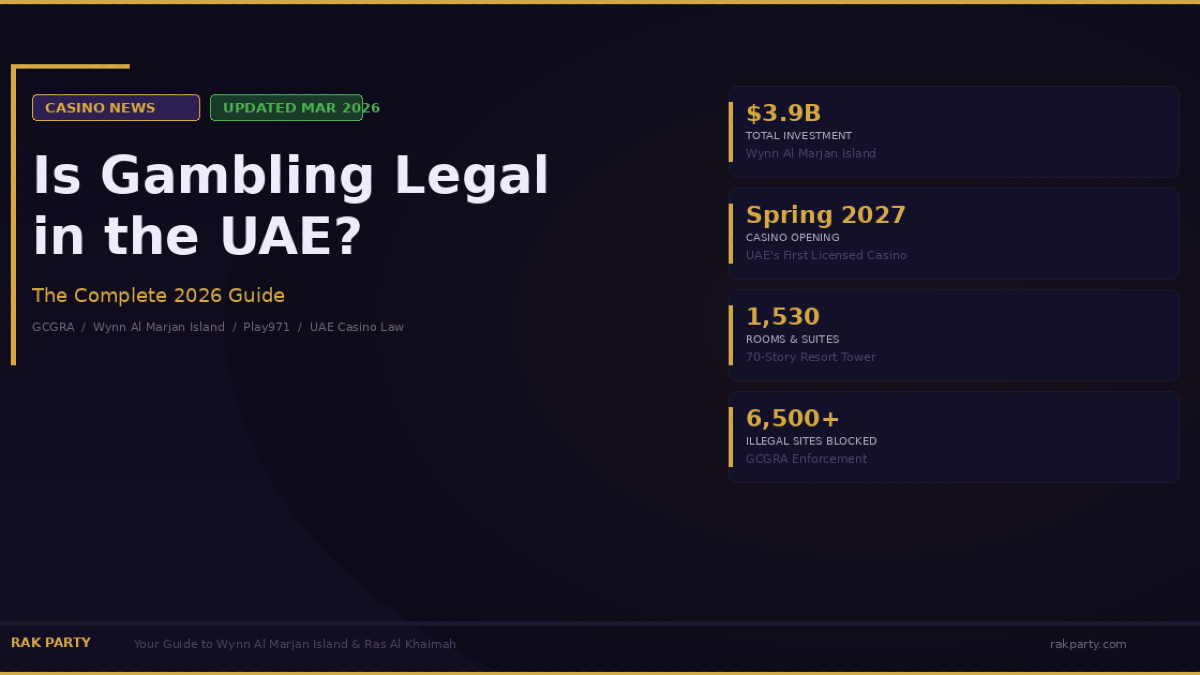
Since then, the pace of change has been remarkable. The UAE has issued a national lottery license. It has granted the country's first commercial casino operator license to Wynn Resorts for a $3.9 billion integrated resort in Ras Al Khaimah. It has licensed its first online gaming and sports wagering platform. It has issued over fifteen B2B technology vendor licenses to companies including Aristocrat, Light & Wonder, IGT, Konami, and Sportradar. And as of June 1, 2026, the civil code itself will no longer contain a single provision addressing gambling or betting.
This is not incremental change. It is a wholesale restructuring of the legal landscape around gaming in one of the world's wealthiest and most closely watched economies.
This guide breaks down everything that has happened, what the current legal framework looks like as of March 2026, and what it means practically if you are planning to visit, currently living in the UAE, or evaluating the market as a business.
The Short Answer
Gambling is legal in the UAE, but only through operators licensed by the General Commercial Gaming Regulatory Authority (GCGRA). Unlicensed gambling in any form remains a criminal offense with severe penalties. As of March 2026, licensed gaming includes a national lottery, a land-based casino resort opening Spring 2027, an online gaming platform, and a growing ecosystem of licensed B2B vendors. The GCGRA has issued 19 licenses since its founding in September 2023.
How the UAE Got Here: From Prohibition to Regulated Gaming
Understanding the current state requires understanding the starting point. Gambling was addressed in two primary pieces of legislation.
The UAE Penal Code (Federal Law No. 3 of 1987) criminalized gambling participation and operation. Participants faced fines up to AED 20,000 or imprisonment of up to two years. Organizers faced sentences of up to ten years. The Civil Transactions Code (Federal Law No. 5 of 1985, Articles 1012-1021) addressed gambling-related disputes, including whether gambling contracts could be enforced and under what conditions gambling losses might be recovered.
Beyond the law, the Telecommunications Regulatory Authority enforced an Internet Access Management policy requiring ISPs to block gambling content. Culturally, gambling was treated as incompatible with the values underpinning UAE society.
The first public indication that this position might shift came in January 2022, when Wynn Resorts announced a partnership with Marjan and RAK Hospitality Holding to develop an integrated resort on Al Marjan Island in Ras Al Khaimah. The project was described as including a "licensed gaming" component. At the time, no legal framework existed to support that claim.
Eighteen months later, the framework arrived.
The Regulatory Timeline: 2023 to Present
Here is every major milestone, in order.
- September 3, 2023: The UAE announced the establishment of the General Commercial Gaming Regulatory Authority (GCGRA), headquartered in Abu Dhabi. Established by federal decree, the GCGRA was given exclusive jurisdiction over all commercial gaming activities and facilities across all seven emirates. Kevin Mullally, a veteran of US gaming regulation, was appointed as founding CEO.
- January 2024: Existing raffle operations, including the popular Mahzooz and Emirates Draw, paused operations to apply for licensing under the new framework. This signaled that even legacy quasi-gaming products would not be grandfathered in.
- July 2024: The Game LLC, a subsidiary of Momentum Corporate Services, received the first official license from the GCGRA to operate the UAE Lottery. Ticket sales launched shortly after.
- October 2024: Wynn Resorts received the UAE's first commercial gaming operator license for its Wynn Al Marjan Island integrated resort. Reporting indicates Wynn holds a 15-year license from the GCGRA. This was the GCGRA's second license overall.
- July 2025: Light & Wonder became one of the first gaming technology vendors licensed by the GCGRA, followed by Live88 (part of Yolo Group, operating as a live casino studio) in October 2025.
- April 2025: The GCGRA signed a memorandum of understanding with New Jersey's gaming regulators, signaling that the UAE is modeling its framework on mature US jurisdictions rather than lighter-touch offshore regimes.
- November 28, 2025: Play971, operated by Coin Technology Projects LLC, went live as the UAE's first licensed online gaming and sports wagering platform. The GCGRA formally added Coin Technology to its Internet Gaming and Sports Wagering registers on December 1.
- December 2025: The GCGRA published its Commercial Gaming Policy document, reporting that it had blocked over 6,500 illegal gambling websites and disrupted 71% of identified illicit gaming activity since its founding. By this point, the regulator had issued 19 licenses across operators, vendors, and key persons.
- January 2026: Analysis of Federal Decree-Law No. 25 of 2025 confirmed that the new Civil Transactions Law, taking effect June 1, 2026, removes the entire gambling and betting section (Articles 1012-1021) from the civil code. Legal reviews by Greenberg Traurig confirmed the provisions were neither retained nor relocated.
The GCGRA: How UAE Gaming Regulation Actually Works
The General Commercial Gaming Regulatory Authority is not a department within an existing ministry. It is a standalone federal executive entity with its own mandate, leadership, and enforcement powers. That distinction matters.
The GCGRA's jurisdiction covers four categories of commercial gaming:
- Lottery operations (cash and prize draws)
- Internet gaming (online casinos, eSports betting, fantasy sports, mobile gaming)
- Sports and event wagering (betting on sports outcomes)
- Land-based gaming facilities (physical casinos with table games, slots, and related offerings)
According to the GCGRA, commercial gaming refers to "any game of chance, or combination of chance and skill, where an amount of money, in cash or cash equivalents, is wagered for the purpose of winning a sum of money or other valuable items." That definition is intentionally broad, designed to capture emerging formats without requiring legislative updates.
License Types
The GCGRA issues five categories of licenses across two groups:
Entity licenses: Gaming Operators (B2C licenses for casinos, online gaming, sports wagering, lotteries), Gaming-Related Vendors (B2B licenses for technology, content, payment, and data providers), and Key Person Corporate entities.
Individual licenses: Key Person Individuals (directors, senior executives, significant stakeholders) and Gaming Employees (staff in sensitive roles).
Every applicant undergoes a thorough assessment covering financial strength, organizational capability, risk controls, AML/KYC frameworks, and a detailed responsible gaming plan. As legal analysis from Pinsent Masons notes, the GCGRA evaluates not just the entity and its proposed activities but also its directors, senior management, and the responsible gaming infrastructure it plans to deploy.
Player Protection and Responsible Gaming
This is where the UAE framework distinguishes itself from lighter-touch regimes. The GCGRA has built responsible gaming into the foundation of its licensing requirements, not as an afterthought.
Licensed operators must implement:
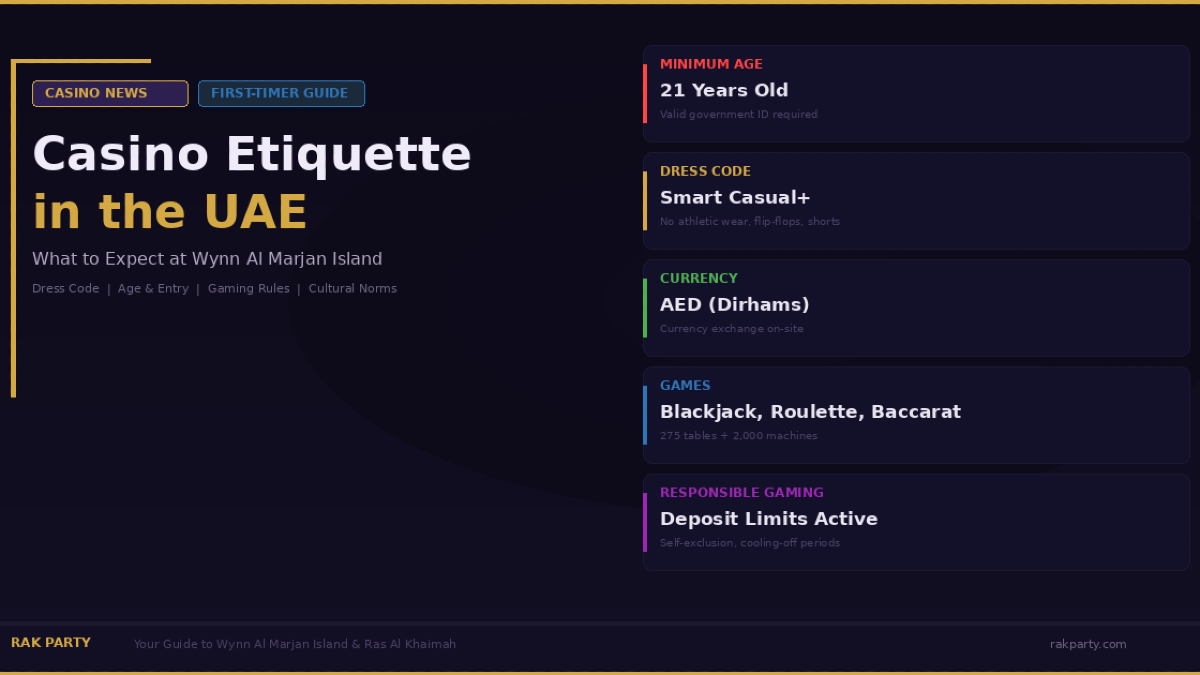
- Deposit limits on a daily, weekly, and monthly basis, with controlled escalation rules
- Cooling-off periods of at least 72 hours, during which operators must cease all communication with the player
- Self-exclusion programs with a minimum duration of six months, during which players cannot place bets or deposit money
- Safeguards against underage gambling (minimum age is 21, not 18)
- Monitoring for risky behavior patterns with targeted interventions
- Access to external mental health and counseling resources, including services like Takalam
- Mandatory appointment of a dedicated responsible gaming officer within every licensed operation
- Comprehensive employee training on identifying and responding to problem gambling
- Regular audits every two years by GCGRA-approved auditors
The framework aligns with international best practices from the UK Gambling Commission, Singapore's Gambling Regulatory Authority, and mature US state regulators. The GCGRA has explicitly stated that gaming should function as entertainment, not as a means of generating income.
What Is Licensed and Operational Right Now
The UAE Lottery
The Game LLC, part of the Momentum group, launched the UAE's first licensed lottery in mid-2024. It remains the longest-running licensed gaming product in the country. Existing raffle brands like Mahzooz and Emirates Draw were placed under GCGRA supervision but have not been authorized to expand beyond their previous scope.
Wynn Al Marjan Island: The UAE's First Casino
This is the project that put UAE gaming on the global map. Wynn Al Marjan Island is a $3.9 billion integrated resort under construction on Al Marjan Island in Ras Al Khaimah, approximately 50 miles from Dubai International Airport and 15 minutes from RAK International Airport.
The numbers tell the story of its scale:
Feature | Details | Status
Casino Floor | 20,900 sqm main casino (225,000 sqft) | Under construction
Sky Gaming Casino | Secondary casino on 22nd floor | Under construction
Hotel Rooms | 1,217 resort rooms | Interior fit-out underway
Enclave Suites | 297 ultra-luxury suites (hotel-within-hotel) | Interior fit-out underway
Additional Residences | 2 Royal Apartments, 4 Townhomes, 10 Marina Estates | Under construction
Tower Height | 352 meters (70 floors) with spire | Topped out Dec 2025
Restaurants & Lounges | 22 venues (Ducasse steakhouse, Delilah supper club) | Announced
Marina | 98-berth deep-water marina for superyachts | Under construction
Beach | 420 meters of private white-sand beach | Completed
Events Center | Coral Court: 7,700 sqm column-free ballroom | Announced
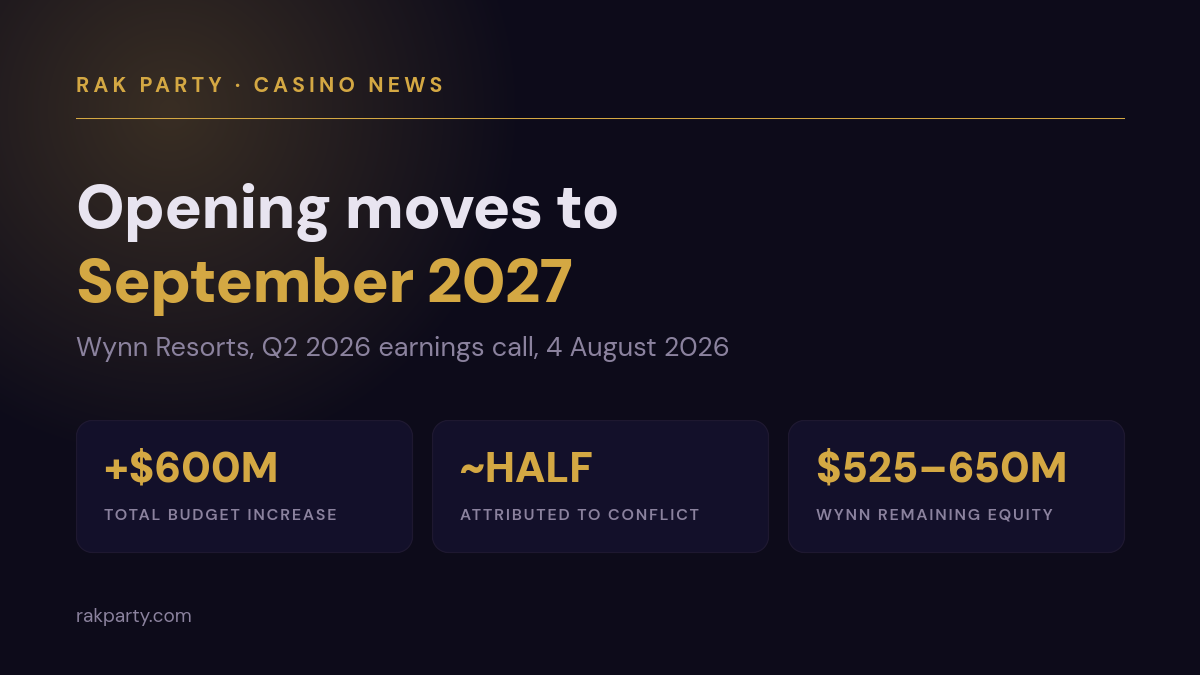
Opening | Spring 2027 | On schedule
The tower topped out in December 2025, reaching 283 meters of structural concrete across 70 floors in just 27 months from foundation. Over 438,968 cubic meters of concrete have been poured. The facade is 79% complete with 19,206 of 26,247 panels installed. Interior fit-outs are active across 1,504 of the 1,530 rooms. The Wynn Bridge, a 548-meter connection linking the resort to the E311 and E611 highways, is 48% complete and on track for late 2026.
Wynn Resorts CEO Craig Billings has projected the UAE gaming market at $3 to $5 billion in gross gaming revenue annually, with Wynn holding 100% market share at launch. The company expects the property to add $345 million of EBITDAR to its existing base. Through Q3 2025, Wynn had contributed $835 million in cash to the joint venture, with an additional $525 million planned.
GCGRA Chairman Jim Murren has indicated that up to four integrated resorts could eventually operate in the UAE. No additional casino licenses have been publicly announced. Wynn also acquired Crown London Aspinalls in early 2025, rebranded as Wynn Mayfair, specifically to funnel British high-rollers to the RAK property.
Follow the latest progress in our Wynn Al Marjan Island construction updates.
Play971: Online Gaming and Sports Wagering
Play971 launched on November 28, 2025 as the UAE's first licensed online gaming platform. It is operated by Coin Technology Projects LLC, which shares an address with The Game LLC (the lottery operator). Both entities are linked to Momentum Corporate Services.
The platform offers online casino games (slots, live dealer roulette, blackjack, poker), and sports wagering across football, cricket, tennis, basketball, and other events. Game suppliers include OneTouch (Yolo Group), with sports data from Sportradar.
Key operational details, as reported by Gulf News:
- Minimum age: 21 years old (not 18, as in many other jurisdictions)
- Physical presence required: Players must be physically inside the UAE while using the platform
- Geofencing: Access is blocked from "sensitive geographic areas" as defined by the GCGRA
- UAE nationals: Emirati citizens must comply with additional emirate-specific requirements before registering
- Self-exclusion: Minimum six-month self-exclusion period available
- Deposit controls: Daily, weekly, and monthly deposit limits
- Support services: Direct referrals to mental health and counseling resources including Takalam
The platform launched in a field trial phase, initially accessible in Abu Dhabi and Ras Al Khaimah. As of March 2026, a broader rollout is underway. Industry reports from Bird & Bird and Vixio GamblingCompliance suggest the GCGRA may adopt a model of one online gaming operator per emirate, which would allow up to seven licensed platforms nationally.
The June 2026 Civil Law Change
This is arguably the most significant structural shift in the entire timeline, and it is happening in just a few months.
Federal Decree-Law No. 25 of 2025 introduces a new Civil Transactions Law that replaces the existing Federal Law No. 5 of 1985 on June 1, 2026. The existing civil code contains Articles 1012 through 1021, a dedicated chapter governing gambling and betting under civil law. This chapter addresses whether gambling contracts can be enforced, how gambling debts are treated, and under what circumstances gambling losses can be recovered.
In the new civil law, that entire chapter is gone. Legal analysis by Greenberg Traurig, reported by SiGMA World, confirmed the provisions were neither retained nor relocated elsewhere in the civil code.
What this means in practice: from June 2026, civil courts in the UAE will no longer have a dedicated legal framework for gambling disputes. Instead, all gaming-related matters will fall under the GCGRA's specialized regulatory framework, its licensing conditions, compliance requirements, and enforcement mechanisms.
This is not deregulation. It is the opposite. The UAE is moving gambling out of general civil law and into a purpose-built regulatory regime designed specifically for the gaming sector. For operators, it provides clarity. For consumers, it creates a single point of oversight with dedicated player protection tools. For the market, it signals that the UAE is building a permanent, institutionalized gaming industry rather than tolerating an ad-hoc expansion.
How the UAE Framework Compares Globally
The UAE is not creating its regulatory model in isolation. The GCGRA framework draws from established gaming jurisdictions, and the MOU with New Jersey regulators underscores this alignment.
Singapore is the closest structural parallel. Singapore's Gambling Regulatory Authority restricts its own citizens from freely accessing casinos (citizens pay a S$150 daily entry levy), while allowing foreign visitors unrestricted access. The UAE appears to be following a similar logic by imposing additional requirements on Emirati nationals while the expatriate population (roughly 88% of UAE residents) forms the primary domestic market.
Nevada and New Jersey provide the licensing DNA. The GCGRA's five-tier licensing structure, emphasis on individual background checks, AML requirements, and responsible gaming mandates all mirror mature US state frameworks. The fact that the GCGRA's founding CEO came from US gaming regulation reinforces this connection.
Where the UAE diverges from most markets: scarcity. With potentially only one land-based and one online operator per emirate, the UAE is creating a highly controlled, limited-license environment. This is closer to Singapore's two-casino model than to the hundreds of licensed operators in the UK or Europe. That scarcity is a deliberate design choice, maintaining exclusivity while generating significant revenue from a small number of premium operators.
What Happens If You Gamble Illegally
The regulatory shift toward licensed gaming has not softened enforcement against unlicensed activity. If anything, enforcement has intensified.
For participants: Fines between AED 250,000 and AED 500,000 (approximately $68,000 to $136,000 USD), potential detention, and asset confiscation.
For organizers: Prison sentences of up to ten years under the Penal Code, plus criminal prosecution under anti-money laundering frameworks.
For online activity: Using unlicensed offshore gambling platforms, including through VPNs, carries the same financial penalties. The GCGRA has actively blocked over 6,500 illegal websites.
The GCGRA's consumer advisory is explicit: players who use unlicensed platforms, whether online or at a physical venue, may also be subject to penalties. The distinction is sharp and absolute: licensed operators are legal, everything else is not.
What Tourists Need to Know
If you are planning a trip to the UAE and want to visit a casino, here is the practical picture.
The only licensed land-based casino will be Wynn Al Marjan Island in Ras Al Khaimah, opening Spring 2027. There is no casino in Dubai, Abu Dhabi, Sharjah, or any other emirate. No additional casino licenses have been announced.
Ras Al Khaimah is approximately 45 to 60 minutes from Dubai by car via the E11 highway. RAK International Airport is expanding with new direct flight routes from Poland, Romania, Russia, Uzbekistan, the Czech Republic, and Saudi Arabia. A new VVIP private aviation terminal targeting completion in 2027 will serve high-net-worth travelers arriving by private jet.
The emirate is already a destination in its own right. RAKTDA reported a record 1.35 million overnight visitors in 2025 (up 6% year over year) with tourism revenue growing 12%. Key source markets include India (+14%), the UK (+10%), Romania (+41%), and the CIS region. The emirate is targeting 3.5 million annual visitors by 2030, and the Wynn opening is the centerpiece of that strategy.
Beyond the casino, RAK offers the Jebel Jais zipline (the world's longest), desert safaris, luxury beach resorts along Al Marjan Island, a growing roster of five-star hotels (Four Seasons, Fairmont, Taj, and Aman's Janu brand are all opening), and a dining scene that is expanding rapidly in anticipation of casino tourism. Read our guide to the best tourist places near Wynn Al Marjan Island for a detailed breakdown.
What UAE Residents Need to Know
For expatriates living in the UAE (approximately 88% of the total population), the new framework opens regulated access to gaming through licensed channels.
Play971 is the first online option, offering casino games and sports betting to eligible users. To register, you must be at least 21 years old, physically present in the UAE, and not located in a GCGRA-designated sensitive geographic area. Wynn Al Marjan Island will add a land-based option in Spring 2027.
For UAE nationals (Emirati citizens): Current regulations indicate that Emiratis face additional requirements, and possibly restrictions, on gaming access. Play971's terms state that UAE citizens must "comply with any applicable requirements, if any, in their emirate of residence" before registering. The specific nature of these requirements varies and may depend on the policies of individual emirates. This mirrors Singapore's approach, where citizens face entry levies and additional controls at casinos.
For all residents, the critical point remains: licensed platforms are the only legal option. Using VPNs to access offshore gambling sites, participating in underground card games, or engaging with any unlicensed operator carries the same legal risk it always has. The GCGRA is actively enforcing against illegal activity, and penalties have not been softened.
What Businesses and Investors Should Watch
The commercial opportunity around UAE gaming extends well beyond the gaming floor.
Real estate: Al Marjan Island property prices jumped 21% year over year in early 2026, driven by the Wynn development. New luxury developments from Emaar, Sobha, BEYOND Developments, and others are launching on and around the island. Branded residences are attracting significant international investment interest.
Hospitality: Four Seasons, Fairmont, Taj, NH Collection, and Aman's Janu brand have all announced RAK developments. The emirate aims to double its hotel room count by 2030. MICE and wedding tourism revenue grew 25% in 2025.
Gaming supply chain: Over fifteen B2B vendor licenses have been issued to date. Companies like Aristocrat, Light & Wonder, IGT, Konami, Sportradar, and Arena Racing Company have secured early approvals. The B2B licensing regime is active and growing.
Employment: The Wynn construction phase alone generated over 18,000 jobs. Wynn is building Wynn Oasis, a purpose-built residential community for 7,000+ employees across 26 acres, opening Summer 2026. Hiring for resort operations began in May 2025.
Tourism infrastructure: RAK International Airport is expanding with new terminals and routes. The Wynn Bridge connecting the resort to the UAE highway network is on track for late 2026. These infrastructure improvements benefit every business in the emirate.
For RAK-based businesses looking to reach the tourist and investor audience arriving around the Wynn opening, RAK Party offers advertising partnerships.
Frequently Asked Questions
Is there a casino in Dubai?
No. There is no licensed casino in Dubai as of March 2026. The only licensed casino in the UAE is Wynn Al Marjan Island in Ras Al Khaimah, opening Spring 2027. RAK is about 45-60 minutes from Dubai by car.
Can tourists gamble at Wynn Al Marjan Island?
Yes. International tourists and expatriate residents will have access to the casino. UAE nationals face additional requirements that may vary by emirate.
Is online gambling legal in the UAE?
Only through GCGRA-licensed platforms. Play971 is currently the only licensed online gaming and sports wagering platform. It requires users to be at least 21, physically in the UAE, and not in a GCGRA-designated sensitive area. Using unlicensed platforms remains a criminal offense.
What is the minimum gambling age in the UAE?
21 years old. This applies to both online platforms (Play971) and will apply to land-based casino entry at Wynn Al Marjan Island. This is higher than the 18-year minimum common in many other jurisdictions.
What happens if I gamble illegally in the UAE?
Fines between AED 250,000 and AED 500,000, potential detention, and asset confiscation for participants. Organizing unlicensed gambling can carry prison sentences of up to ten years.
When does the Wynn casino open?
Spring 2027. The 70-story tower topped out in December 2025. Interior fit-outs are underway across all 1,530 rooms. Follow our construction updates for the latest milestones.
How many casinos will the UAE have?
GCGRA Chairman Jim Murren has suggested up to four integrated resorts in the coming years. For now, Wynn Al Marjan Island is the only licensed casino. No additional casino licenses have been announced. Wynn Resorts expects two competitors to emerge over time in a market worth $3-5 billion in annual gross gaming revenue.
Will there be a casino in Abu Dhabi or Sharjah?
Nothing has been announced. The GCGRA has jurisdiction across all seven emirates, but casino development has been concentrated in Ras Al Khaimah. Industry reports suggest a model of one land-based operator per emirate, but more conservative emirates are unlikely candidates in the near term.
What is the GCGRA?
The General Commercial Gaming Regulatory Authority is the UAE's federal body with exclusive jurisdiction over all commercial gaming licensing, regulation, and supervision. Established in September 2023 and headquartered in Abu Dhabi, it has issued 19 licenses to date. Visit the official GCGRA website for more information.
Can I use a VPN to access offshore gambling sites from the UAE?
No. Using unlicensed gambling platforms is illegal regardless of how you access them. The GCGRA and telecommunications authorities actively block illegal gambling sites and have disrupted 71% of identified illicit gaming activity. Penalties for unlicensed gambling apply to players as well as operators.
Where This Is Heading
The UAE is not tiptoeing into gaming. It is building one of the most tightly regulated, deliberately structured gaming markets in the world. The GCGRA controls licensing with an iron grip. Player protections are baked into the framework from day one, not retrofitted after harm occurs. Enforcement against unlicensed operators is aggressive and well-resourced. And the legal infrastructure is being rewritten at the civil code level to accommodate the new reality.
For the region, this is unprecedented. No Gulf state has ever built a regulated gaming industry of this scope. The closest analog is Singapore, which transformed its tourism economy by introducing two integrated resorts in 2010. The UAE appears to be studying that playbook closely while adapting it to local conditions.
For anyone watching from the outside, the trajectory is clear: the UAE's gaming industry is in its earliest stages, but the foundation is already far more developed than most people realize. The Wynn opening in Spring 2027 will be the moment it becomes visible to the global public. Everything happening now is the infrastructure being laid to support that moment and everything that follows.
Subscribe to the RAK Party newsletter for ongoing coverage of every development as it happens.